
There Will Be More of Us: Rachel Stagner on STELLA, ARSET & Growing a NASA Mission-Literate Workforce
About Rachel Stagner
Rachel Stagner is STEM Coordinator and science educator at Templeton Academy in Washington, D.C., and a NASA Climate Change Research Initiative (CCRI) Associate Researcher/Educator. Over 15 years of teaching — across physics, chemistry, biology, ecology, and a dedicated NASA Earth Science Research course — she’s developed a thoughtful, practical approach to bringing NASA science into the classroom.
STELLA in the Classroom
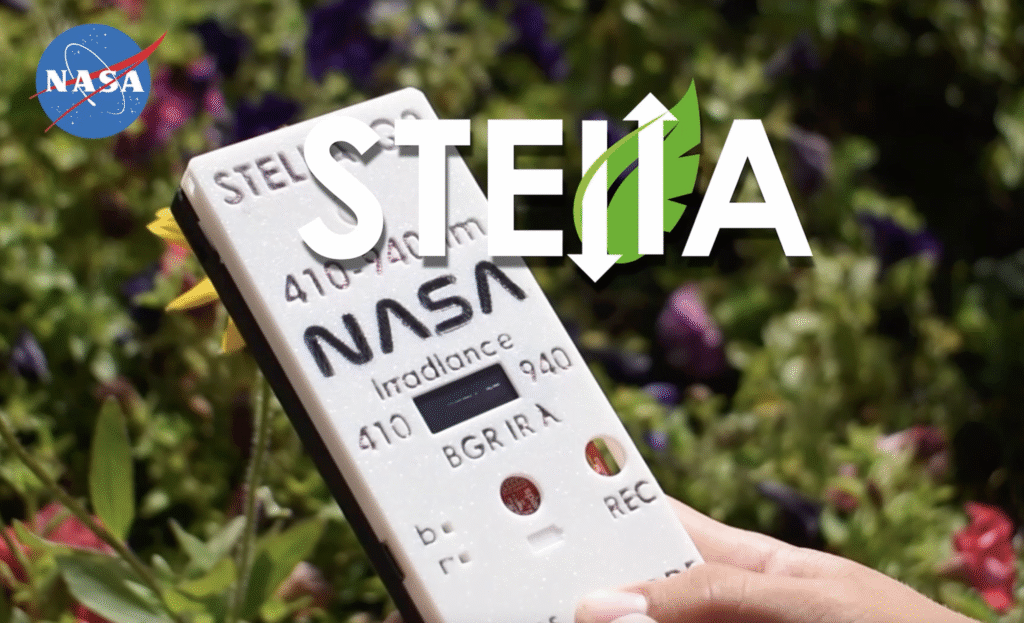
STELLA (Science and Technology Education for Land & Life Assessment) is a suite of low-cost, open-source instruments developed under the NASA Landsat mission, with components Commercial of the Shelf (COTS) parts. Rachel uses STELLA to give students genuine hands-on experience, circuit assembly, embedded programming, data collection, and spectral analysis in an approachable, buildable format.
One of the things she finds most valuable is the connection STELLA creates between what students can measure in their own neighborhood and what Landsat is capturing from orbit. That link between a small handheld instrument and a NASA satellite mission helps students start to see where they might fit in the larger picture of Earth science.
ARSET as a Starting Point
Rachel introduced ARSET, NASA’s free Applied Remote Sensing Training Program, at the very beginning of her NASA Earth Science class, spreading the introductory module across five or six class periods before students moved into hands-on work.
Students who came in with little or no remote sensing background began asking questions about how satellites collect data and how observations get turned into imagery.
A particular highlight was an ARSET unit using Jupyter Notebooks to map cyclone data — it generated more student excitement than anything else she’d seen that semester.
Her takeaway: ARSET and STELLA work well together precisely because they serve different purposes. ARSET helps build the conceptual foundation. STELLA gives students something concrete to do with it. Used together, they offer a natural progression from learning about remote sensing to actually doing it.
"There Will Be More of Us"
When Rachel talks about where she hopes this work goes, the throughline is community. She’d like to see professional development treated as an ongoing cycle where teachers who attend a workshop come back a few months later to share what they’ve tried, and eventually help facilitate for the next group.
She also likes the idea of a STELLA Share-A-Thon: a low-key, celebratory space where students can show what they’ve done with their instruments and hear what other students across the country are exploring. Something like comparing plant health data between cities nothing overly formal, just students and teachers learning from each other.
The hope is that each workshop, each teacher, each student who engages with these tools makes it a little easier for the next person to find their way in.
Resources
- STELLA: https://landsat.gsfc.nasa.gov/stella/
- ARSET: https://appliedsciences.nasa.gov/what-we-do/capacity-building/arset
- STELLA Community Forum: https://github.com/STELLA-Landsat/STELLA/discussions
STELLA / ARSET Interview Transcript
Interviewer: Mike Taylor (NASA GSFC, Landsat Outreach Scientist) Guest: Rachel Stagner (STEM Coordinator & Teacher, Templeton Academy, DC)
SEGMENT 1 — Introduction & Background
(00:00:08 – 00:02:14)
MIKE TAYLOR: First off, thank you for joining us. Can you introduce yourself and tell us a bit about your background as an educator? How did you end up teaching at Templeton Academy and what subjects do you cover?
RACHEL STAGNER: Sure. My name is Rachel Stagner. I’ve been teaching for about 15 years. I started in 2009. I started teaching in Portland, Oregon, and that’s where I got my master’s degree in education, as well as a master’s of science in teaching. And then I moved to DC — it was summer of 2018 — for the Einstein Fellowship, which I did at NASA, and then I ended up staying in DC. The next year, 2019–2020, I got a position here at Templeton Academy. So I’m the STEM coordinator. I also teach basically everything because we’re a very small school. So I’ve taught physics, chemistry, biology, various variations of biology, ecology, human ecological history, and I’m teaching a NASA Earth science research class. Right now I’m teaching marine biology, so I teach basically everything. The only things I don’t feel comfortable teaching at this point are an advanced physics class or a really advanced chemistry class. Other than that, I can teach it all.
MIKE TAYLOR: That’s great. It’s a little bit — yeah, it’s kind of overwhelming when I think about it.
RACHEL STAGNER: I’m like, oh my goodness. Yeah.
MIKE TAYLOR: So I mean, I respect you — you wear a lot of hats.
RACHEL STAGNER: That is correct.
MIKE TAYLOR: PAEMST — do you call it “pamst” award?
RACHEL STAGNER: I don’t know.
MIKE TAYLOR: Oh yeah. Yeah, yeah. The Presidential Award for Excellence in Math and Science Teaching, which was actually discontinued last year, but —
RACHEL STAGNER: In 2023, I applied and I was named a finalist. And then in January of 2024, they released the list of winners.
SEGMENT 2 — CCRI Program, STELLA & Curriculum
(00:03:09 – 00:05:17)
RACHEL STAGNER: With the Einstein Fellowship and the Aeronautics Mission Directorate, I learned a lot there that I was able to apply. Like, I did an engineering course when I first started teaching at Templeton, and we were able to use some of those things. But last summer when I did the CCRI program, we developed a curriculum module focused on the five teacher teams and the research projects that we were working on. So we created a unit plan. And I think my goal all along was to try to use that unit plan in a new class and kind of focus it around NASA Earth science research. So I learned a lot during that experience about satellites and remote sensing, and this whole class is based on that curriculum — but also helping students navigate things like how to collect data, how to pull data from NASA resources, as well as ARSET, which I always forget the acronym, but they are ARSET training programs. So they’ve been using that to help them understand remote sensing, NASA Worldview, and NASA Eyes on Earth. So hopefully all these resources are going to help them.
We are finishing up our last unit on urban heat islands right now. And then starting after spring break in April, they’re going to start to choose their own adventure and pick a topic that we’ve covered — or something maybe tangentially related to it — that they can either use NASA Earth data for, or go out and collect data on their own, maybe a little combination of both based on their interests. So that is hopefully the plan. So far it’s going well, and I hope to incorporate STELLAs maybe even as soon as next week — to try to introduce them to the students and have them do some basic experiments so they can kind of understand the purpose and the value of them. And yeah, we’ll see what happens.
SEGMENT 3 — STELLA Workshops & Growing the Community
(00:06:11 – 00:10:32)
RACHEL STAGNER: And we keep offering more this year, which is really great. So the goal there is to offer free PD to teachers. We’ve partnered with American University and the DC Space Grant to help post us and to do the hard work of finding us a place to be on a regular basis. So it’s been really great.
MIKE TAYLOR: And then, what drew you to the NASA STEM Education Ambassadors program? And what has the experience been like so far as a practicing teacher?
RACHEL STAGNER: I mean, Matt is the one who told me about it. And as CCRI fellows last year, we were invited to be a part of it. So I’m continuing it. But this year, I think the value of it, from my perspective, is the networking. I’m lucky enough because I’ve had a chance to be with NASA a couple of different occasions wearing different hats, so I know a lot about the resources that are shared — but that doesn’t mean I can’t learn more stuff. So every time we have one of the meetings, I’m hopefully learning more about the ways that people are using it. But also I think the networking is very important. For example, Nick and I met during one of the meetings — the office hours. So he and I are now hopefully going to collaborate a little bit to do something with STELLA. And he has a student who —
MIKE TAYLOR: Yes.
RACHEL STAGNER: So Matt Pearce and Nick — Nick Barbi. That’s it. Yeah. So like Nick Barbi, another teacher, is really interested in incorporating STELLA in his classroom. He’s done some work with that. So I think that’s the power. I think what I’d like to use the STEM Ambassador program for is to find other teachers who want to collaborate on projects that don’t just take place where we are, but maybe comparing data across different classrooms, different states, all of that.
And then — Ryan Miller and I and other CCRI fellows basically put on that professional development, which STELLA was part of. So that was really great. I think I learned a lot more about STELLA and also started to think about how other people could use it in their classroom. And the one that we did here in January, same thing. Like every time I’m having a chance to build a STELLA or help other people build a STELLA, I learn a little bit more about how to use it myself. And so I am continuing that knowledge.
Hopefully now I have a colleague here in DC — Brooke — who I’m working with on that project. And so there’s more of us now. Hopefully there’s more of us. It’s like that Hamilton song — like there’ll be more of us, right? Like, so we’re going to just keep hopefully doing things with STELLA so that we can all bring it to our kids, because STELLA is a great program and needs more support, and it doesn’t have the kind of built-out support that you would expect for, like, a commercial product.
MIKE TAYLOR: Right.
RACHEL STAGNER: And so I’m happy to help with some of that. And I think that’s the power of keeping up with these kinds of professional developments — it just gets more people who are interested in doing that.
SEGMENT 4 — Introducing STELLA to Students
(00:10:35 – 00:12:53)
MIKE TAYLOR: So you haven’t introduced STELLA formally to your classes, as you said, but you’re hoping to bring NASA Earth science to students soon.
RACHEL STAGNER: The students soon, likely after spring break in early April. Yeah, that was the main factor in the timing.
MIKE TAYLOR: And what does the runway to introducing that look like for you? What did you intend to do with your students?
RACHEL STAGNER: We’ve got — I think the runway to it was I wanted to have the first part of the class be the introduction to different tools. That’s where the curriculum came in, because now they’ve been learning about all the different ways that NASA Earth science research can help inform us about the Earth and how scientists do that. So the point of bringing STELLA in was to give them another tool. So as they start to think about their own questions — here’s another tool that you can use. You can potentially build it themselves. We’ll see if anyone’s interested in doing that, and then also use it to collect data. So I think that’s kind of the rationale about why and when.
In terms of the on-ramp for it, I think I’m going to model what I do with them using some of the basic stuff that the teachers and I were doing at some of the workshops — like obviously showing them how to use it, how it works, why it works. And just having them go collect data. I think that’s probably going to be the easiest thing. I’ll probably have them come up with a basic question, and then just go collect some data, and then hopefully give them some structure of how to analyze it, because I think that will also be very cool for them. Which is another reason why taking the R class is helpful, because as I get better with manipulating the data and figure out what you can do with it, I’ll be able to help the kids with that too. So that’s the goal. That’s the timing part of it.
SEGMENT 5 — How ARSET Prepares Students for STELLA
(00:12:57 – 00:15:43)
MIKE TAYLOR: Well, and in that respect, you had mentioned ARSET. So how are you using it to prepare your students, or have them use it with STELLA, so they can get a better understanding?
RACHEL STAGNER: We used ARSET the first couple weeks of the class. I had assigned them the introductory module. Like, there’s five parts of it, I think. So we broke it up over like five or six class periods where they were doing one module. And then we talked about it and they had a little check-for-understanding quiz — which, spoiler alert, was just questions from the ARSET modules that I just used for in-class understanding, which was great.
I think it was a really good way for them to be introduced to what satellites do and how remote sensing works. And I think a lot of them — they told me they really enjoyed it. And when I did it last summer as part of the CCRI experience, I found it very useful and it taught me a lot. And so I just figured that instead of me trying to fumble my way through trying to teach them a lot of that stuff, ARSET actually did a better job with all the visuals and the connections to satellites already built in. So that prepares them because it will actually give them some kind of background with which to understand what the STELLA is doing. And also whatever they choose to do for their research, if they want to —
Like, I just give an example: since we’re doing urban heat island stuff right now, if they wanted to do data collection on the ground with infrared thermometers or pollution sensors or whatever, they could actually go back and compare that data to NASA satellite data. And I think they will have a better idea of how that data is collected and how it’s used.
And at the end, I know the last module in the ARSET training is looking at a couple of examples of how to use it. So while it’s not exhaustive, I think if any kids want to challenge themselves with something that ARSET has a training for, I can also point them towards that module and hopefully help them figure out what to do with huge NASA data sets.
That’s why I like the STELLAs too, because these data sets are not massively huge — and while complicated to deal with as all data sets are, they’re not as overwhelming as a satellite download.
MIKE TAYLOR: So would you say it’s sort of a nice bridge to understanding some NASA data and making it more — don’t put words in your mouth —
RACHEL STAGNER: Oh yeah, for sure. Yeah. I think it’s definitely a bridge to help them figure out how to go from small-scale data collection to massive data collection.
SEGMENT 6 — Student Responses & STELLA Engagement
(00:15:59 – 00:19:27)
MIKE TAYLOR: And so how have the students responded to ARSET content so far? Have you seen the light bulb moments you were hoping for?
RACHEL STAGNER: Yeah, I think so. I think — I always think — it’s a small class, there’s only nine of them. So I talk to them often about what are you enjoying. Like after every mini unit I’m like, hey, what did you like? What did you not like? — which I’m going to share with Matt Pearce. But also after the ARSET modules, like after we did a kind of check for understanding quiz, like they were doing really well with that.
MIKE TAYLOR: Yes. Yeah. For sure. So I think that they’re going to be very fascinated by this, which is fun. So and then I mean, along with the data science and all that — STELLA supports a wide range of engineering skills, from circuit design and 3D printing to optical engineering and data analysis. Which of those dimensions do you think will most resonate with your students, and why?
RACHEL STAGNER: I think the analysis part, because I’m not sure if we will actually build any for the students. So while I think the engineering part is really interesting and fascinating, and eventually I’d like to have that happen — because this class is so broad and kind of focused on just Earth science in general — I don’t know if any students will choose to go that route. If they did, that’d be great. I do have a couple of kids who are really interested in engineering that I think we can build around, and I’ll push that for those kids.
SEGMENT 7 — Kenneth Leslie’s Summer STELLA Boot Camp
(00:19:29 – 00:22:00)
RACHEL STAGNER: I think the data analysis part is going to be the most useful. And probably the investigation design — like the thinking of how we can use this tool. So understanding its capabilities and then trying to come up with some kind of investigation, and then take that data and do something with it. I think that will be the most useful part for these kids.
I do know that this is kind of related-unrelated to that — another teacher, Kenneth Leslie, he came in at the end of our STELLA PD on the 24th of January. He’s actually doing a summer engineering workshop. Did you know about this?
MIKE TAYLOR: Oh, wow. I haven’t told you about this yet.
RACHEL STAGNER: Okay, so DC Public Schools has programs. One is CRI — I can’t remember what that stands for. The other one is like a summer work program. And again, I’ll get you the acronyms if you want them. But he does — because there’s not a lot of internship availability with engineering and STEM in DC proper — and he teaches at McKinley Technical High School. He basically every summer creates opportunities for the students. Some of those things are like the rover programs that NASA used to have. But this year he’s created a six-week like boot camp on STELLA. So I’m maybe helping with him. The goal was to have like five of my students and 20 of his students in this, and we’re going to start at American University where the kids are going to learn and build and 3D print everything, and then go from that to the data collection to the eventual presentation of something that they’ve created — some sciencey data and analysis.
MIKE TAYLOR: He’s a busy man.
RACHEL STAGNER: He’s a busy man. So I haven’t really been able to pin him down. He’s got this whole plan. He’s talked to Chelsea and American University and the DC Space Grant. And this is hopefully moving forward. I may or may not be able to help with that. But that’s the plan. So there’s even more in the works. And I think that Kenneth is such a great advocate for everything STEM in DC that if he gets his claws into STELLA — which he has — he will probably use it pretty regularly, which is great.
MIKE TAYLOR: And now would you recommend, like, say, him using ARSET — you know, so maybe they build their STELLA and then they need examples of how to use it and all that. So would you recommend using ARSET to start understanding some of these investigations that they might be able to make and actually do some comparisons with NASA data too, or anything like that?
RACHEL STAGNER: Yeah, absolutely. I think — oh, would you implement it? Yeah. I would basically — I mean, I think that could be part of the “how does remote sensing work” — right, and how do you take remote sensing data —
SEGMENT 8 — STELLA and ARSET as Complementary Tools
(00:22:36 – 00:25:04)
RACHEL STAGNER: And they’re not parallel tools. I think, depending on a student’s interests — especially if they’re coming in with not a lot of background information on remote sensing in general — I think it provides a good foundation for understanding that. And then if you kind of make that natural connection — like there’s just like a mini satellite in a lot of ways — then they kind of understand how it works and then even start to maybe think about what kinds of data they could collect with it and how it connects to the bigger missions at NASA or science. And again, the idea of — you know, this is what the satellites do, you’re able to do this with a small instrument and in a smaller scale around your school, around your neighborhood, around your community. It might even lead them to think about how they could compare the data that they’ve collected with the satellite data.
But also I think some of the other ARSET modules are specifically about how to use certain data sets and what to do with them. And I think that based on a kid’s interest, it could be a natural fit to help point them towards some of those resources to help them learn about what they might be able to do with the data after they’ve collected it.
SEGMENT 9 — What Teachers Need to Feel Confident
(00:25:08 – 00:27:37)
MIKE TAYLOR: As a nationally recognized STEM educator and someone who has worked at NASA — so you’ve seen both sides — what do you think teachers most need to feel confident to bring real NASA science tools into their classrooms?
RACHEL STAGNER: I think a lot of it is knowledge. One of the things that I experienced when I was at headquarters was it was like a fire hose. There’s so much stuff that NASA does and also so much educational material — that I think just the knowledge of what NASA has in terms of educational programming and lesson plans and then like these different things like the Aerokat and the STELLA and all of the different kinds of side things that people are able to do with NASA tools and data — I think that’s the most important thing, and that is the limiting factor. It’s just not well known. You know, you get these specialists that have maybe heard of a program and they’ve done that, right. But the sharing of that is somewhat limited, I think, or just there’s so much of it that it’s just overwhelming. So I think exposure is a big one.
And then I think professional development is also a big thing. Like if you can help teachers understand how to use some of these tools, that is always a great way to get them to do it. I think when you’re introduced to a lot of things — like I said, the firehose effect — you’re like, wow, there’s so many things. But then there’s often not enough time to digest all of it and to figure out what you might do with it. So good professional development helps you not only learn about stuff but also do it so that you can help your students do it later. I think that’s the key. So targeted stuff like what we’ve been doing with the STELLA workshops is great.
I think following up on that — I would like to do a follow-up session because the motivation always starts out high. You know, these teachers who come to these are self-selecting — they want to come and learn about the stuff. But then the realities of the school day and the school year and life, and not having potentially people to collaborate with, can kind of slow progress.
SEGMENT 10 — Follow-Up PD & Cycling Teachers Back
(00:27:38 – 00:28:24)
RACHEL STAGNER: So I think just following up on stuff is important too. Like if you do a STELLA workshop, let’s do another one in like three months and have these people back and then, hey, what have you done? What are you thinking? You know, that kind of stuff. So it’s like a cycle of professional development — with a lot of NASA tools, that’s important.
MIKE TAYLOR: Yeah.
RACHEL STAGNER: And I think ideally, if I were to do that, I’d like the folks who already did that workshop to possibly help proctor the next workshop. So they get the other side of the experience as well.
MIKE TAYLOR: Right. I think that would also really help as well — building those skills.
SEGMENT 11 — Advice for Teachers New to STELLA or ARSET
(00:28:31 – 00:30:11)
MIKE TAYLOR: So, for a teacher watching this interview who’s curious about STELLA or ARSET but doesn’t know where to start — what would you tell them? I know you’ve given some hints, but — I mean, ARSET’s free?
RACHEL STAGNER: I mean, ARSET’s free. So I would log in and take the first module yourself. And I think that would be a good place for a person coming into this whole field of wanting to do this in their classroom with not a lot of background information — that’s a great place to start. I didn’t have a lot of background information. That’s why it was such a good place for me to start.
And then in terms of the STELLA stuff, I think if you are someone who teaches engineering, or any kind of circuit design, or mostly computer science, I think they could probably look at a lot of that material and figure it out and maybe use it. I think going to professional development, if you have one in your area, is great. Or just — reach out. I think just finding out where you can go and build one, if you can’t build it yourself, or talking to other people who have used it — I think is really valuable. So even like the STEM Ambassadors, or any other resources that they can find, because it’s a little intimidating — you know, it’s just a really cool instrument. But if your background is not strong, then it might be intimidating. So I think reaching out to people who have used it — and I think the GitHub is a good idea to help spur discussions. I’d like to see more of that. I think that’s where you start.
SEGMENT 12 — Vision for the Future of STELLA & ARSET
(00:30:16 – 00:32:18)
MIKE TAYLOR: Finally, what’s your vision for where STELLA, ARSET, and the community of educators can go over the next few years? And what would success look like to you? And then of course, if there’s anything else you’d like to add that I’ve neglected, please feel free to do so.
RACHEL STAGNER: I think that this is going to have to kind of be a grassroots effort — teachers who want to learn more about it and who want to collaborate to kind of do those things. Right, like that. Would that be successful? To me, it’s like — I think Nick Barbi mentioned — like if we had some kind of a STELLA competition where students were able to share the research that they’d done in their classrooms. And maybe it’s not a big formal competition, but even just a share-a-thon where students are like, “Hey, I did this really cool thing.” I think that would be a success. I would like to see that.
I would like to be able to collaborate with either people here in the district — like on a small scale — or teachers in other places, to have their students do a project with STELLA and then compare that to something that I’m doing in my classroom. Like I’m just giving an example — maybe we wanted to look at, I don’t know, plant health in another city and compare it to plant health here. That’s not the perfect example, but like something that could be measured in multiple locations, right? And then the kids could be like, hey, we found this here. And what did you guys find? I think that builds not only buy-in from the kids, but also gives them the sense that it’s not just what’s happening in our classroom that’s important. Like we actually can collaborate with other classrooms and other teachers to see even more about the world than what we can measure here in our area.
So that’s what I think would be successful to me — creating these communities of practice with STELLA where teachers are talking to each other, and then maybe even having some kind of a place where students who are using STELLAs can share with each other. That would be very successful, I think.