

From Desert Flowers to Future Frontiers: How Three UCSB Students Put NASA's STELLA-Q2 to the Test
Sometimes the most meaningful science begins not in a laboratory but in a conversation. For Ingrid Roberson and Clara Laughlin, two undergraduate geography students at the University of California, Santa Barbara, it started with a field trip to the Anza-Borrego Desert and an encouragement from their graduate student mentor, Sarah Payne, to ask their own questions.
Sarah had previously attended a demonstration of NASA’s STELLA-Q2 at Goddard Space Flight Center and recognized its potential as a more accessible alternative to the bulky, expensive ASD FieldSpec Pro the team had been hauling into the desert for their wildflower research. She brought the idea back to her students, and Ingrid, with Clara’s help, ran with it. The question they set out to answer was straightforward but scientifically meaningful: how well does the STELLA-Q2 actually perform when placed side by side with the industry standard?
The Instrument
The STELLA-Q2 is part of NASA’s Science and Technology Education for Land/Life Assessment (STELLA) program, developed by NASA Goddard Space Flight Center scientists and university collaborators to place research-capable spectral instruments within reach of students, educators, and researchers who might otherwise never have access to them. Built from commercially available components at a total cost of approximately $200, the instrument measures reflected light across 18 spectral channels from 410 to 940 nanometers. Its spectral bands align with those of Landsat 8 and 9, allowing ground-level measurements to be connected to satellite data and enabling the calculation of vegetation indices such as the Normalized Difference Vegetation Index (Mirel et al., 2025).
It is worth being clear about what that alignment means and what it does not. The high-precision, high-accuracy instruments in NASA’s Earth Observing fleet represent a level of engineering investment and calibration rigor that cannot be reproduced with off-the-shelf components (Mirel et al., 2025). STELLA occupies a different and complementary role. It is a bridge: a low-cost entry point into the scientific concepts, field methods, and data literacy that give meaning to the observations those missions produce. In doing so, it helps cultivate the researchers and technical professionals that Earth observation science depends upon for its future (Mirel et al., 2025).
Supporting that mission, NASA is developing a dedicated STELLA Field Guide that will standardize measurement protocols, reference panel selection, and data quality practices for users at every level. The hard-won field lessons from projects like this one, including insights about field of view differences, white reference selection, and tissue-specific instrument behavior, are precisely the kind of real-world experience informing that resource. For students like Ingrid, Clara, and Sarah, the field guide represents something they could have used when they started and something they are now, in a meaningful way, helping to shape.
One of the things she finds most valuable is the connection STELLA creates between what students can measure in their own neighborhood and what Landsat is capturing from orbit. That link between a small handheld instrument and a NASA satellite mission helps students start to see where they might fit in the larger picture of Earth science.
The Project
Working at the University of California Natural Reserve System’s Steele/Burnand Anza-Borrego Desert Research Center, and supported by a Mildred E. Mathias Graduate Student Research Grant, the team collected paired measurements of brittlebush (Encelia farinosa), a desert native selected for its bright yellow flowers, which provided a spectrally distinctive and demanding test case for assessing instrument performance across different plant tissue types. Leaf, flower, and bare soil samples were measured with both instruments, and reflectance values were compared across all 18 overlapping spectral bands using root mean square error analysis and Bland-Altman statistical methods.
The fieldwork required genuine problem-solving. One of the central challenges was accounting for the difference in field of view between the two instruments. The STELLA-Q2 has an angular field of view of plus or minus 20 degrees, with a pixel diameter on the target surface approximately 0.7 times the standoff distance (Mirel et al., 2025). The ASD operates differently, making it difficult to ensure both instruments were capturing exactly the same surface area simultaneously. Working through that geometric difference became a hands-on lesson in optical instrument design that no classroom could have fully provided.
Calibration presented its own complexity. The ASD was referenced against a professional-grade Spectralon panel, while the team used a folded white sheet of paper as the reference for the STELLA-Q2, reasoning that it better represented what most users would have available in the field. In discussion with NASA’s Michael Taylor at Goddard Space Flight Center, it emerged that other recommended low-cost alternatives would include polystyrene foam or an opaque white cutting board, affirming that the layered white paper used by the team is also a valid approach. Reference material selection is not a minor detail in reflectance science, and working through that question gave the students direct experience with the practical judgments that determine data quality in real-world deployments.
What They Found
The results told a nuanced story. The STELLA-Q2 closely matched the ASD across the visible spectrum and showed strong agreement in visible-band indices. Systematic deviations emerged, however, in the near-infrared region across all sample types, and mean root mean square error exceeded the acceptable threshold of 0.02 for every tissue type measured. Flowers showed the highest error at approximately 0.11, while leaves were the most reliable at approximately 0.075. Bias was small but consistent, with leaf and soil measurements slightly underestimated and flower measurements slightly overestimated (Laughlin and Roberson, 2026). The findings confirm that the STELLA-Q2 is not a direct substitute for the ASD in high-precision applications, but they also point clearly toward next steps: developing instrument-specific calibration corrections, particularly for near-infrared bands and flower tissue, to improve accuracy for vegetation index-based analyses.
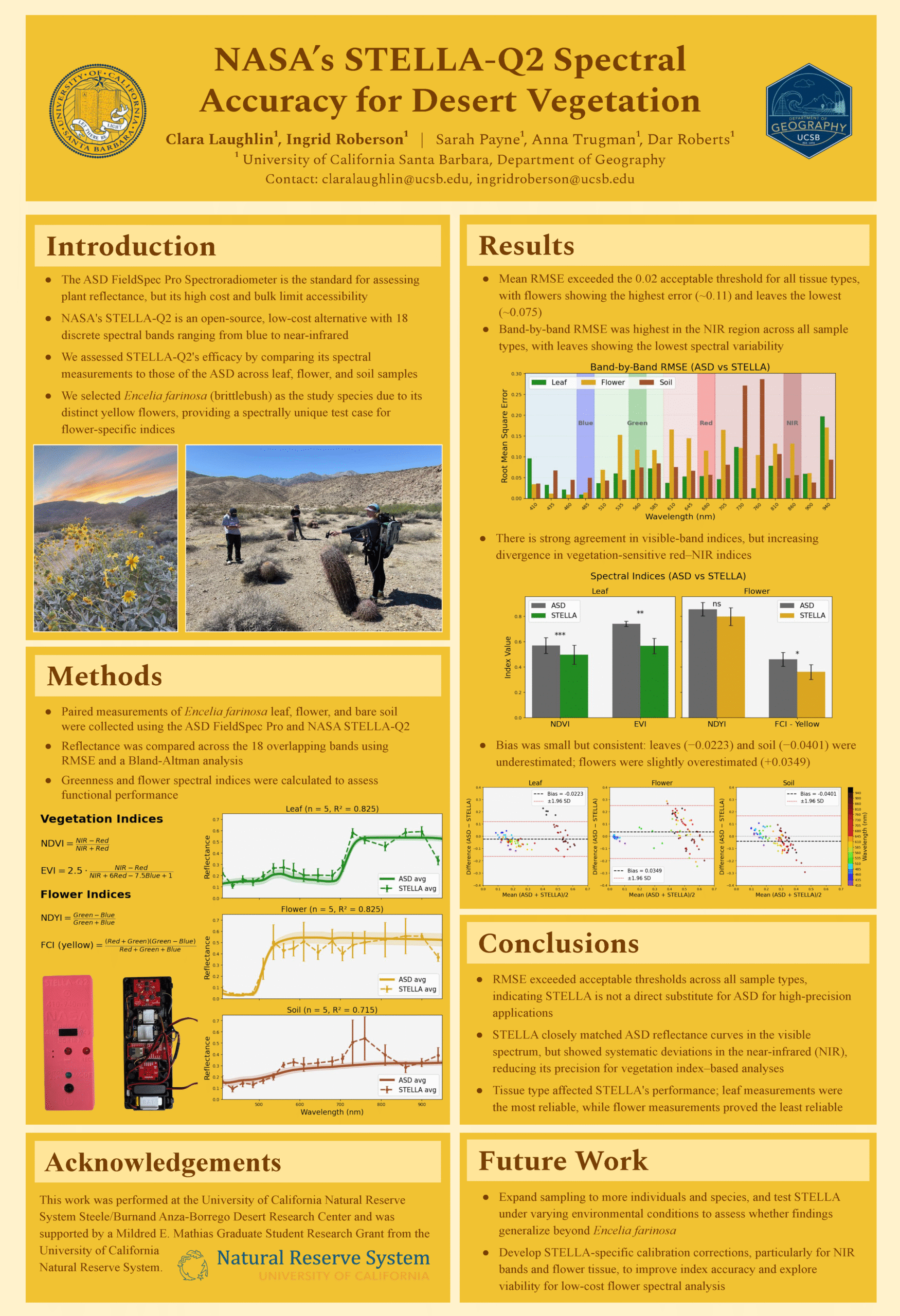
+ Q2 STELLA Data
What It Meant for the Students
The scientific findings matter, but so does what happened to the people who produced them. Ingrid began the project with only an introductory remote sensing course behind her. By the end, she was reasoning through sensor design, optical geometry, and statistical methodology, and she is now planning to pursue a graduate degree in remote sensing. Clara extended her understanding of how ground-level spectral measurements connect to satellite imagery, work she has since applied to an invasive species monitoring project with Sarah. Sarah herself, despite years with NASA’s DEVELOP program, described the experience of building and working with the STELLA as giving her a foundational understanding of instrumentation she had not developed before.
This progression reflects what NASA’s STELLA program was designed to produce. By lowering the cost and complexity of scientific instrumentation, STELLA broadens who gets to participate in science and, by extension, who is prepared to carry it forward (Mirel et al., 2025).
Looking Ahead
The students recognized that the ability to monitor plant health and flowering behavior with a portable, low-cost sensor carries implications well beyond the Anza-Borrego Desert. Understanding how plants respond to stress, how they flower, and what their spectral signatures reveal about physiological state is knowledge that matters for food systems on Earth, particularly in communities without access to expensive satellite or drone-based monitoring. It is also knowledge that will matter in environments where every resource is carefully managed, where plants must be grown far from natural sunlight, and where lightweight instruments capable of reliably assessing crop health could prove indispensable. The students did not set out to design tools for those environments. But in learning to validate a small, open-source spectrometer in one of the most demanding landscapes on Earth, they took a meaningful step in that direction.
Citations
Mirel, P., Taylor, M. P., Barber, W. J., Campbell, P., Cilento, B., Nichols, L. M., and Lerdau, M. (2025). Science and Technology Education for Land/Life Assessment (STELLA): Democratizing Remote Sensing Science With Low-Cost Open-Source Instruments for Research and Education. Perspectives of Earth and Space Scientists. https://doi.org/10.1029/2025CN000284
Laughlin, C. and Roberson, I. (2026). NASA’s STELLA-Q2 Spectral Accuracy for Desert Vegetation. University of California, Santa Barbara, Department of Geography. Spring 2026 Research Poster.
Interview Transcript
Interviewer: Mike Taylor (NASA GSFC, STELLA Outreach Scientist) Guests: Clara Laughlin, Ingrid Roberson, Sarah Payne
00:00:08:13 – 00:00:24:13
My name is Clara Laughlin, and I am a third year geography student at UC Santa Barbara. I first got interested in environmental science and geography and remote sensing and all of that in my freshman year of college.
00:00:24:14 – 00:00:58:01
I didn’t really know that much about it before coming to college, and I came in undeclared, but I took a few geography classes and started doing work with Sarah my freshman year. And ever since, I’ve just been very interested in remote sensing and like the practical applications and environmental applications of it. And this past year, I’ve been taking a remote sensing series where we’ve learned kind of like the basics in the fall quarter and then kind of how to apply it throughout winter quarter and now spring quarter.
00:00:58:01 – 00:01:04:13
We’ve been doing a project to assess, like agroforestry systems in Honduras.
00:01:04:15 – 00:01:32:00
Yeah. So I’m Ingrid Roberson I am actually a recent graduate of UCSB geography. I just finished in March. I first got interested in environmental science through my AP Environmental Science class. Actually in high school my senior year, came into college as an environmental science major and then discovered the geography department at UCSB and thought it sounded super cool.
00:01:32:02 – 00:01:55:13
So I switched over into geography and got exposure to remote sensing just through classes. And then I also started working with Sarah my junior year, and we both went to go for some field work, and then Sarah encouraged us to take on some independent projects, which led to this STELLA project. And I also took this remote sensing series with Clara, but I didn’t.
00:01:55:13 – 00:01:58:06
I’m not in the last class since I just graduated.
00:01:58:07 – 00:02:21:03
Hi, Mike. Nice to meet you. I’m Sarah Payne. I’m a third year PhD student here at UCSB, working with Dara Roberts in the geography department in Anna Truman. And I use spectral and mixing to look at wildflower blooms, in this case an Anza-Borrego. I’m throwing back all the way to what got me interested in environmental science remote sensing in undergrad.
00:02:21:04 – 00:02:40:12
I actually was a global studies major for a while, and I did some volunteering in Joshua Tree National Park, and I just happened to meet the person who was in charge of GIS for the national park. Talk to him for a little bit and totally changed my whole career path. Yeah, so that’s a little bit about me.
00:02:40:13 – 00:02:43:04
Yeah, I guess I could explain.
00:02:43:08 – 00:03:20:02
I decided to work with the STELLA per Sarah’s recommendation. Actually, after our field work the first time in Anza-Borrego, or the second time or not the first time, and my she kind of encouraged us both to do some independent projects. And she had heard about this STELLA device, this lemony spectrometer, and we had been using this huge spectrometer, the big ASD field spec, and she was like, hey, it would be super cool if you like, as your project looked at how good the STELLA is and how it works and just kind of look into it.
00:03:20:03 – 00:03:42:02
So that ended up being my sort of independent project. I put my computers getting a little hot, so if I start lagging, just just let me know. But yeah, so our interest was, I guess in this case we were using it to look at desert vegetation, specifically brittle bush. So they have like really bright yellow flowers.
00:03:42:04 – 00:04:13:04
So kind of on theme with Sarah’s desert wildflowers research. Yeah. And Clara helped help me out, too. Yeah, I, I was working on a different project in the greenhouse at school, but I’ve helped out with the field trips and definitely know the the downsides to the ASD. So it was exciting to test out a new, more portable and accessible spectrometer.
00:04:13:06 – 00:04:15:01
00:04:15:02 – 00:04:30:04
Yeah, like I don’t know if you remember last, this was a while ago now, but I was actually a graduate student mentor with NASA on the East Coast. So we stopped by Goddard Space Flight Center and you gave a demo of the STELLA. And I was like, whoa, this is super cool. I should try to see if we can work on it.
00:04:30:04 – 00:04:49:03
And that’s what sparked it all, because I was planning to go into the field with ASD and it’s expensive, hard to manage heavy. But I was like, STELLA could be a great solution. And then Ingrid really took it from there.
00:04:49:05 – 00:05:13:07
Yeah. So I let’s see my individual expertise. I was sort of trying to find a way to connect it to the larger project we were doing out in fieldwork. So I think I was mainly just encouraging the undergraduate students to think about different questions that could be asked with this instrument, providing feedback on their code and their poster deliverables and things like that.
00:05:13:07 – 00:05:23:12
Also getting the funding for the device took, you know, took me a hot second, even though it’s very affordable. And yeah, that was kind of my role.
00:05:23:14 – 00:05:38:05
Yeah. And then me and Clara were kind of field hands at first in answering with Sarah and then, yeah, I guess my role was I kind of took on the STELLA project and comparing it to the ASD.
00:05:38:07 – 00:06:10:11
But with Sarah’s help, of course, her guidance was super helpful. It was my first time doing sort of a really independent research project. So yeah, that is I helped with the the fieldwork aspect, but I would say it was definitely mainly in goes project with the STELLA. I did more of the the flower analysis in the field, but it was really fun to kind of compare the STELLA and the ASD and get more familiar with the STELLA when making the poster.
00:06:10:13 – 00:06:35:11
who built the STELLA I did, yeah, we we have two of them. Technically we have a pink one and a black one that we just 3D printed at the UCSB or I guess I 3D printed at the UCSB library. But yeah, it was super easy. I had never 3D printed anything before, so the fact that everything was downloadable and the instructions were super clear, that was really awesome.
00:06:35:11 – 00:06:56:05
And like all the forget what they’re called, but the files like the 3D printing files were all in there. Just sent them into the UCSB makerspace and they printed it all out. I got to choose the colors and everything, and that was kind of fun. Yes. We have a pink one, which we call STELLA, and the black one that we call Luna just for for fun.
00:06:56:05 – 00:07:02:15
Yeah. So we don’t get confused.
00:07:03:00 – 00:07:24:14
Yeah. First we initially like noted that the general reflectance curves were pretty good for the STELLA, just like the general shape, at least. Yeah, we thought so. We did notice it. Kind of. It would jump around a little bit when the reflectance got really high, or in the near infrared too.
00:07:24:14 – 00:07:52:05
So we wanted to then quantify that and actually see if like, that was just us looking at it and thinking it looked weird, or if it was actually something that was maybe a significant difference. Yeah. Yeah. And we calculated two different like vegetation indices and then two different flower indices just to kind of give it a more like applicable context, I guess.
00:07:52:06 – 00:08:03:07
And then we also performed a root mean square error analysis to quantify a bit more and be able to like graph the differences.
00:08:03:09 – 00:08:33:02
And did you did you use the same type of calibration to normalize both of them? No. For the ASD we used the spectral on panel, which is yeah, if you’re probably familiar, it’s like super flat white surface. And then for the STELLA we use just like a regular white napkin, per the recommendations online, because we thought that might be more not.
00:08:33:03 – 00:08:59:06
I guess I shouldn’t use the word reflective in this context. More accurate of what other people might be using the STELLA for. They probably don’t have a spectralon panel like we luckily do. So we thought a white napkin would be more so more functionality across different different people using it. Does that make sense? That’s interesting. We don’t use away napkin.
00:08:59:07 – 00:09:17:14
I don’t know where you got the white napkin from. That’s funny. So there’s that. We were actually looking at a few. So the the next one would have been a polystyrene foam. But ideally, if you’re going to do the comparison, you would have wanted to I mean, I’m just going to you would use the spectralon as well.
00:09:18:00 – 00:09:50:04
And if you’re going to use a low cost, use the ASD field spec also on the polystyrene foam and the spectralon so you can bounce back and forth and get those and then do the flour. And were you doing when you were doing the spectral on or the napkin and all that. Did you did you do it just once and then take the measurement, or did you bracket it where you did, you know, once before measurement and then once again afterwards and then get the average betwixt those two?
00:09:50:05 – 00:09:56:00
Yeah. For this the STELLA we did sandwich white. References. Every cool
00:09:56:02 – 00:10:26:08
Based on your experiences, what are some of the critical elements you would emphasize in developing standardized field protocols for future STELLAr deployments, particularly for ensuring data quality and consistency? We started just chatting about that. Yeah, definitely a consistent white reference, a good idea and making sure you’re doing them. Taking the white references every other or after, before and after every measurement.
00:10:26:10 – 00:11:00:02
Yeah, I am kind of blanking right now. Yeah. I think maybe similar to the ASD having a pretty consistent routine. If you’re doing like especially with flowers for the contact probe, we would usually do like a leaf mosaic or a flower or a pedal mosaic. So I think just having consistent just a consistent process for each measurement that you’re doing, like if you’re taking the contact probe approach, then maybe always doing it at about the same like four inches or so.
00:11:00:03 – 00:11:13:08
And then if you are doing or sorry for pistol grip and then if you’re doing more of a contact probe, just making sure that you have the whole sensor area covered.
00:11:13:10 – 00:11:25:03
Yeah. I think for, especially for comparing it to the ASD, a better understanding of the field of view and why that’s important and how much area you’re actually capturing compared to a different instrument you’re using.
00:11:25:03 – 00:11:38:06
Is is really important. And something we were trying to mark on the leaves, like what our ASD was capturing versus the STELLA, it was a little different. And it was kind of hard to understand what we were fully capturing.
00:11:38:07 – 00:12:04:13
Beyond the technical aspects, what role do you see? The human element, the training of field personnel, clear documentation of procedures and the ability to adapt to unexpected conditions. Playing in the successful implementation of STELLA Field campaigns. Yeah, I think that clear the clear instructions that were on the website were definitely super helpful for
00:12:04:15 – 00:12:20:01
I think it’s also at least compared to the ASD. I think the STELLA is really useful in the fact that, like, you might have the same number of people in the field that you would with ASD, but not as many like roles necessarily.
00:12:20:01 – 00:12:39:09
Like with the ASD, you’re doing a lot and like you have to have it’s just a it’s a lot to carry on your back. But with the STELLA and it being more portable, I think like the same number of people would actually be more useful because it’s not as big of a task to be the one collecting measurements.
00:12:39:09 – 00:12:51:00
So, I mean, technically, I guess someone could use the STELLA alone in the field and still be pretty efficient, whereas it would be. It’d be pretty hard to do that with the ASD.
00:12:51:01 – 00:13:15:00
And then difficult conditions such as the desert. The the ASD can get a bit overbearing when you’re wearing it for for more than 20 minutes, honestly. And also like we’re both pretty small people, so it’s like really heavy in the belly boards a lot and you just can’t really wear it for very long. Whereas the STELLA is you can use that thing forever because it’s just a little.
00:13:15:01 – 00:13:28:12
It doesn’t get as like overheat. Like the ASD can overheat really easily, which gets pretty hard in the desert. But I think the STELLA is a bit easier to tuck away into a pocket and let it cool down.
00:13:28:13 – 00:14:09:13
So your poster mentions that the mean RMSE exceeded the acceptable threshold, especially in the NIR region, and that the tissue type affected STELLA’s performance with the flowers being the least reliable. Could you elaborate on the specific challenges these for your vegetation index based analyzes? Yeah. So we did see, as you mentioned, that the near-infrared was a bit more had higher error, which for vegetation indices matters a lot because most vegetation or common vegetation indices use near-infrared bands in the calculations.
00:14:09:14 – 00:14:39:11
So that’s definitely a challenge and something you’d want to think about if you were going to use it for vegetation indices. It was definitely a little bit better for flower. The flower indices we use, because they only used the visible bands, which were super good. We saw for the cella, they were pretty, pretty accurate. So yeah, something to keep in mind when you’re using the near infrared bands in any sort of calculations from the STELLA.
00:14:39:13 – 00:15:11:03
Given your findings about STELLA’s performance, particularly its strengths and limitations across different spectral regions and tissue types, what implications might this have for its potential use in detecting stress or health indicators and plants grown in novel environments where every resource counts? Yeah, I guess kind of back to the near infrared region is really important when you’re assessing plant health, because a healthy plant will reflect a lot of near infrared.
00:15:11:03 – 00:15:41:03
So if you’re near infrared bands are a little unreliable or you’re not quite sure if they’re super accurate, it can definitely affect if you can really use it in those, challenging, arid conditions. Clarinets. Plant physiology. Yes. Yeah. Especially with these more rare desert species. It’s kind of hard. There’s they’re not many measurements out there to compare them to.
00:15:41:04 – 00:15:59:09
So knowing that your instrument is reliable, I think is more important than anything, just because you might be one of the only people out there taking those measurements. So you have to be pretty trusting that they are correct.
00:15:59:10 – 00:16:17:10
NASA places a strong emphasis on Stem workforce development. How has your involvement in this project enhanced your skills and understanding of scientific instrumentation, data analysis, and remote sensing techniques, preparing you for future careers in scientific fields?
00:16:17:12 – 00:16:30:12
Yeah, this project was definitely a huge learning experience for me. I actually when I started, I had only taken the intro remote sensing class.
00:16:30:13 – 00:16:54:11
So I had a little bit of foundational knowledge, but definitely still had a lot to learn, especially with instrumentation. I like when I started, I didn’t even consider like that the sensor design might be playing a part in the funky measurements of the leaves. So our luckily our PI is Dara Roberts is super, super knowledgeable about all that stuff.
00:16:54:13 – 00:17:15:06
And he was like, well, did you consider this? Did you consider that? And it just really opened my brain to these topics that I like, had no idea about. I had never even considered. And yeah, actually, part of like, this project kind of inspired me in watching Sarah work on her stuff to. I’m hoping to apply to grad school in remote Sensing.
00:17:15:08 – 00:17:54:01
Not for this coming fall, but the year after. Take a little break first. So. Yeah. Sarah. Sarah. Claire, I couldn’t talk. Yeah. I think having the opportunity to do actual field work with remote sensing has been really impactful for me. I think I learn best by doing things. So actually going out into the field and looking at the graphs like as we collect the spectra really helped, like instill what I was learning in class, especially in like a desert environment when there’s like such a difference between the vegetation and then like the rest of the environment there.
00:17:54:03 – 00:18:20:15
So yeah, using the ASD and also the STELLA was just like it really helped put everything in perspective for me. And then, now Sarah and I are working on an invasives project, so I’m looking more at like the satellite imagery. But I think having that, like, base understanding of when you’re out on the ground collecting those measurements, like how that can help with actually assessing like the bigger picture satellite imagery.
00:18:21:01 – 00:18:41:13
And for me, very quickly, I it’s funny because I before I went to grad school, I worked with NASA develop if you know that program for about two and a half years and also did my undergrad in geography and never before had actually like touched a sensor there, even thought about building the sensor. Like I knew they were important, but I didn’t really understand how they worked at their base level.
00:18:41:13 – 00:18:51:13
And this project, through helping, seeing how Ingrid builds it and trying to help her put the pieces together. Sometimes I really, I really learned a lot.
00:18:51:14 – 00:19:13:01
And you’ve shared a Python script for educational purposes. Can you elaborate on how such tools and hands on experience can help democratize access to scientific exploration and inspire students across various educational levels to engage with environmental monitoring, monitoring, and potential space related research.
00:19:13:02 – 00:19:23:11
Yeah. I mean, I don’t know how much I should say, but I’m I’m originally from Louisiana, where our schools don’t really have that much funding.
00:19:23:11 – 00:19:53:11
I was I went to public high school. So I think like, just instruments like this that are pretty low cost and very easy to use and can be easily understood by students and people who don’t necessarily have, like super Strong Science Foundation’s, I think it’s just super, super valuable that you can just get this thing and put it in the classroom and learn what a spectrum is, and that light is reflected off of things.
00:19:53:11 – 00:20:31:02
Just the base ideas that I wasn’t exposed to until college, probably my upper division college classes. Yeah, I just I think it’s really great. Claritin. Yeah, I totally agree with that. I think just making science more accessible and introducing people to like, spectroscopy and just kind of like these larger ideas that might have like some bigger words, just making it more accessible and less scary, especially the younger age, I think is really important for just making, like science in general, more accessible for everyone.
00:20:31:02 – 00:20:33:03
And
00:20:33:05 – 00:20:51:08
NASA is constantly developing advanced environmental monitoring tools for Earth and beyond. How might the insights gained from understanding STELLA, whose spectral accuracy for vegetation inform the design and development of similar sensors for monitoring plant health and controlled environments such as those for
00:20:51:08 – 00:20:54:15
space, agriculture or extraterrestrial habitats?
00:20:55:00 – 00:21:16:03
the question is like, how can the STELLA. Our findings with the STELLA kind of inform other sensors for similar and different purposes? Yeah. So how would you take what you’ve learned from STELLA? Say, you know, because we are on Spaceship Earth, right? And how would you take that out to, you know, say spaceship mars or spaceship.
00:21:16:06 – 00:21:43:11
Yeah. And so on and so forth. My sister is actually doing some research in that. But no, I think it’s super cool that it’s so small and lightweight. You could probably just strap it to a mars rover. I mean, I’m not quite familiar with how extraterrestrial rovers work, but I imagine you could stick one on there if some high school kids stuck went on a drone, which would be super cool to get some spectra of of Mars that would be sick.
00:21:43:12 – 00:22:01:13
Yeah, yeah, I agree, I think maybe just experimenting and like, like trial and error, seeing what comes back. That’s kind of my idea of how that would work. I guess.
00:22:01:15 – 00:22:24:10
Yeah, I think it would be super cool to apply it to other surfaces of the world. I haven’t even really thought about expanding it that large myself because my focus is such here on earth. But yeah, strap it to a rover, see what happens. I think it’s probably a good first step. Have other have other people thought of applying it to to other planets yet?
00:22:24:11 – 00:22:49:06
NASA’s harvest X initiative aims to develop advanced vegetation health assessment systems for Earth and space. How might the detailed understanding gain from your STELLAr Q2 comparisons, particularly the insights into spectral variability and deviations, directly inform the technical specifications or development pathway for such a system?
00:22:49:07 – 00:23:00:08
Yeah, I guess if it’s for agricultural purposes, you would probably really want that near infrared region. Pretty accurate or at least.
00:23:00:11 – 00:23:50:11
Or at least like be able to predict the variability so that you can get a good assessment of how your crops are doing. Because if you’re not quite sure about your near infrared bands, you probably aren’t quite sure about your agricultural crop health either. Not this is kind of your area of. Yeah. I think, especially knowing the difference between, like, I guess for flowers, it wouldn’t be as helpful, like the petal measurements, but, understanding, like the leaf measurements and vegetation indices and going back to what Ingrid said, like having good measurements of that near-infrared segment to actually, like, apply that, especially in terms of, like satellite imagery, like having good on the
00:23:50:11 – 00:24:08:03
ground measurements through the STELLA and good near infrared measurements to apply it to like a larger scale areas, especially with like agricultural fields being so big, just being able to like accurately assess the bigger satellite imagery.
00:24:08:04 – 00:24:17:10
I think also flowering gives really good indication of pollination or which pollinators might be interested in those certain crops also sort of extending on flowers.
00:24:17:10 – 00:24:36:00
If you’re really familiar with plant pigments, you can easily detect fruit and what might be growing there, how big it is. And I think that is a really interesting expansion from like the more classic leaf soil measurements that could be made with STELLA that we start start assessing with this project. That could go a lot further.
00:24:36:02 – 00:24:51:09
Looking ahead, what excites each of you most about the future potential of low cost accessible spectral sensors like STELLA? Q2? You mentioned a bit of it. And where do you envision this technology making the biggest impact, whether in supporting Earth based environmental monitoring goals
00:24:51:10 – 00:24:55:14
Or advancing our capabilities for sustainable food production. Off
00:24:56:00 – 00:25:20:03
kind of going back to the whole just how accessible it is. I think that is one of its strongest, traits of the STELLA, the accessibility and like in how easy it is to hold and the cost and the like, putting it together is not very hard.
00:25:20:04 – 00:25:45:02
So I think it can make a really big impact. And at least for food systems like places that probably don’t have thousands of dollars for drone satellite monitoring of their fields, the STELLA could be a really could be really impactful in those areas and also just as educational in schools, getting kids excited about science and excited about plants and food systems.
00:25:45:03 – 00:26:17:01
I think it could really be really be great there. Yeah, I totally agree with that. And I think in a more general sense, remote sensing is such a powerful tool that I feel like not that many people even know about or even when I talk to, like my environmental science friends here at school. It like, even though we’re at UCSB and there is such a great, like remote sensing department here, it still is not really that commonly known amongst people.
00:26:17:01 – 00:26:20:06
And I think especially when thinking about food systems
00:26:20:07 – 00:26:54:10
having being able to assess how our plants are reacting to very different and changing environments. I just think it’s a really important tool that like have accessible to people and accessible, but also like easily understandable. And I think making a tool like STELLA that gets people involved, like from a younger age and making it more available in middle schools and high schools, I think is just really important for the our future as like a world really.
00:26:54:12 – 00:26:58:06
I’m really excited to get into more of more students hands.
00:26:58:06 – 00:27:19:02
I think especially with remote sensing and just the pace of technology nowadays, we’re missing a lot of embodied knowledge of just going out into the field, seeing the vegetation firsthand. And the sensor really puts that at the forefront. And I think that’s super exciting. And I want to try the new version. Now that, you know, I see it’s out there, I think that’ll be really cool.
00:27:19:03 – 00:27:40:10
Yeah. Thank you for taking the time out of your day to meet with us and talk to us about our project. My name is Clara Laughlin, and I am a geography student here at UC Santa Barbara. Yeah. Thank you again for being so interested in our project. It’s definitely super validating to hear that NASA wants to talk to us about our about our project.
00:27:40:13 – 00:27:49:14
And yeah, I’m Ingrid Robertson, just graduated from UCSB geography. Super excited for the future.
00:27:50:00 – 00:27:58:13
Yeah, thanks for taking the time, Mike. I’ve loved chatting with you and seeing where STELLA’s going in the future. And I’m Sarah Payne, a graduate student at UCSB.
00:27:58:15 – 00:28:02:14
And this is Mike Taylor from NASA. Signing


