


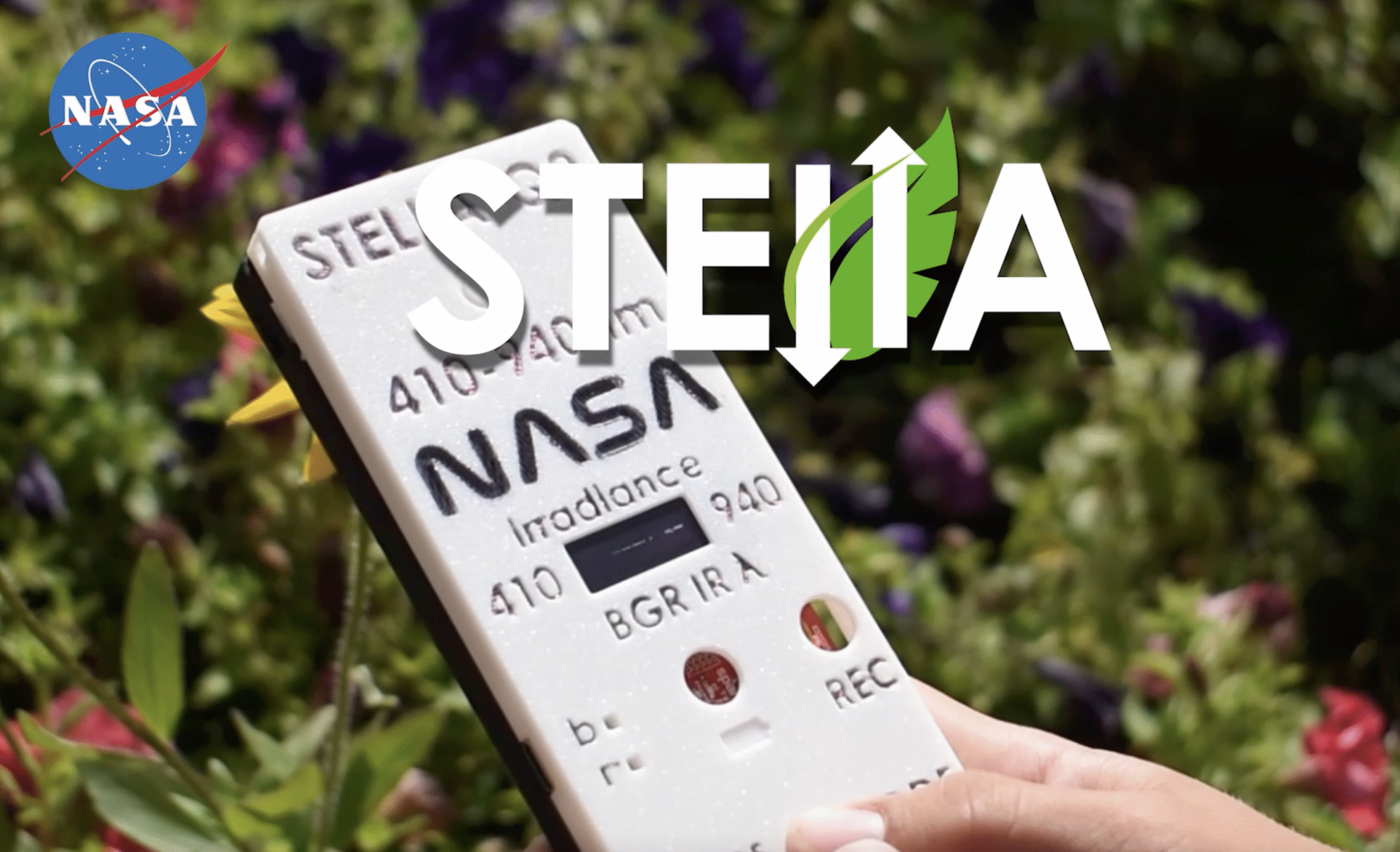
A group of high school students in Michigan is rebuilding NASA's open source STELLA-Q2 spectrometer to help monitor coral health in the Dominican Republic. What started as a classroom exercise became personal the moment they saw real coral bleaching on screen. Since then, they've redesigned hardware, debugged their own code, and learned to work the way professional engineers do, one failure and fix at a time. This is a story about what happens when students are given a real problem and trusted to solve it.

STELLA field team measured Morven's fields alongside NASA drone and G-LiHT surveys to calibrate the low cost, open source spectrometer, while training the next generation of field scientists.

Arizona State University undergraduate Ahadu Assegued spent a year asking a practical question about Earth observation: how do the spectral readings from STELLA, a low-cost open-source spectrometer developed at NASA's Goddard Space Flight Center, compare with those from research-grade hyperspectral imaging and satellite data?

Three UC Santa Barbara students field-tested NASA's $200 STELLA-Q2 spectrometer against a high-end industry standard in the Anza-Borrego Desert. Their hands-on project validated the affordable, open-source tool's potential for environmental monitoring while providing invaluable real-world experience in remote sensing and instrument calibration.

Rachel Stagner is STEM Coordinator and science educator at Templeton Academy in Washington, D.C. has developed a thoughtful, practical approach to bringing NASA science into the classroom.
A group of high school students in Michigan is rebuilding NASA's open source STELLA-Q2 spectrometer to help monitor coral health in the Dominican Republic. What started as a classroom exercise became personal the moment they saw real coral bleaching on screen. Since then, they've redesigned hardware, debugged their own code, and learned to work the way professional engineers do, one failure and fix at a time. This is a story about what happens when students are given a real problem and trusted to solve it.
STELLA field team measured Morven's fields alongside NASA drone and G-LiHT surveys to calibrate the low cost, open source spectrometer, while training the next generation of field scientists.
Arizona State University undergraduate Ahadu Assegued spent a year asking a practical question about Earth observation: how do the spectral readings from STELLA, a low-cost open-source spectrometer developed at NASA's Goddard Space Flight Center, compare with those from research-grade hyperspectral imaging and satellite data?
Three UC Santa Barbara students field-tested NASA's $200 STELLA-Q2 spectrometer against a high-end industry standard in the Anza-Borrego Desert. Their hands-on project validated the affordable, open-source tool's potential for environmental monitoring while providing invaluable real-world experience in remote sensing and instrument calibration.
Rachel Stagner is STEM Coordinator and science educator at Templeton Academy in Washington, D.C. has developed a thoughtful, practical approach to bringing NASA science into the classroom.