
From Orbit to Earth: Agricultural Workforce Development using Real-Time Spectrometry
Video Summary
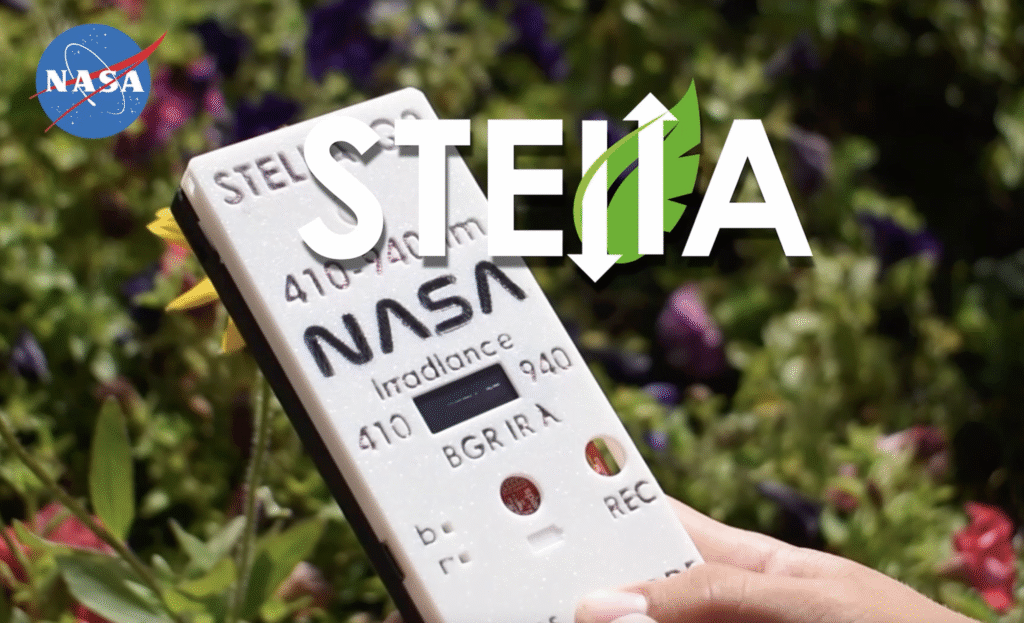
At Garden City Community College in Kansas, Assistant Professor Elisa Mai integrated STELLA spectrometers into her Technology in Agriculture course during fall 2025. The partnership came together when Kansas State University recognized that the college’s newly developed Crop Production Technology program aligned well with NASA ACRES‘ goals. Mai’s program trains students who want to return to family farms or become agronomists, and the STELLA instruments provided a hands-on way to teach remote sensing and precision agriculture concepts. Students used STELLA-1.2 spectrometers alongside Landsat 8-9 satellite data, supplemented with soil data from web surveys and elevation data, to measure spectral differences between surfaces like concrete and grass, and healthy versus stressed vegetation. “Having the STELLAs there was cool because we were able to see at the moment what those wavelengths actually looked like,” Mai explained. The real-time visual display helped students understand wavelength changes that were previously abstract concepts when viewing satellite imagery alone. Students collected field data that the NASA ACRES team—including Jacob Orser, Mike Humber, and Allison Bredder—helped analyze, then completed projects visiting multiple field sites and presenting their findings.
“It made it easy to explain and I think it was cool for the students to see just from walking around and pointing the STELLA at the ground what was happening. I think it really made that part make more sense because when we were looking at satellite data, they’re like, oh, yeah, of course. These points that we’re looking at and we mapped are different. But being able to actually see the jump in those wavelengths was pretty useful.”
– Elisa Mai
Mai extended the technology’s reach by showcasing STELLA at a campus STEM fair, where she demonstrated spectral differences between bare dirt and plants for students and faculty from across the college. She kept explanations accessible, comparing the instrument’s readings to printed NDVI (Normalized Difference Vegetation Index) satellite imagery without overwhelming visitors with complex equations, recognizing that many attendees didn’t know satellites could monitor plant health. This approach helped introduce precision agriculture technology to potential students in a way that felt approachable rather than intimidating. The course introduced basic concepts like different types of light, how satellites are used in farming, and wavelength analysis, with students going out to fields to gather data and bring it back to the classroom for analysis.
For the next course iteration scheduled for spring 2027, Mai plans several improvements based on the first implementation. She wants to provide deeper technical instruction on how STELLA instruments actually function, as students used them successfully but didn’t fully understand the underlying technology. Mai also plans to expand field campaigns beyond measuring around campus—taking students to actual agricultural fields to compare good and bad crop sections so they can see real-world agricultural applications. While the first cohort kept instruction “very, very broad” due to time constraints and the novelty of the material, future students will get more sophisticated training in both the technical aspects of the instruments and their practical applications in diagnosing plant health and field conditions.