Instrument Development
The ongoing research in the Planetary Systems Laboratory focuses on the diverse and interacting systems in our Solar System and exoplanetary systems. This includes 1) atmospheric dynamics and atmospheric chemistry occurring in the atmospheres of Mars, Jupiter, Saturn, Titan, the Moon, and exoplanets, 2) surface and sub-surface processes and compositional properties of Mars, the Moon, asteroids, and comets, and 3) ocean chemistry and circulation occurring in the outer Solar System ocean worlds, including Europa and Enceladus. To study these processes, and their interactions, our laboratory participates in the development, design, and data interpretation of several key planetary flight instruments and missions across the Solar System, in addition to ground- and space-based telescopes. In support of our ongoing research, our Planetary Spectrum Generator tool assists in a broad range of topics, including the analysis of mission data, the development of new instrumentation and missions, as well as exoplanetary and Solar System research. Below you can find the details of a number of the instruments we have worked on.
Heterodyne Instrument for Planetary Winds and Composition (HIPWAC)
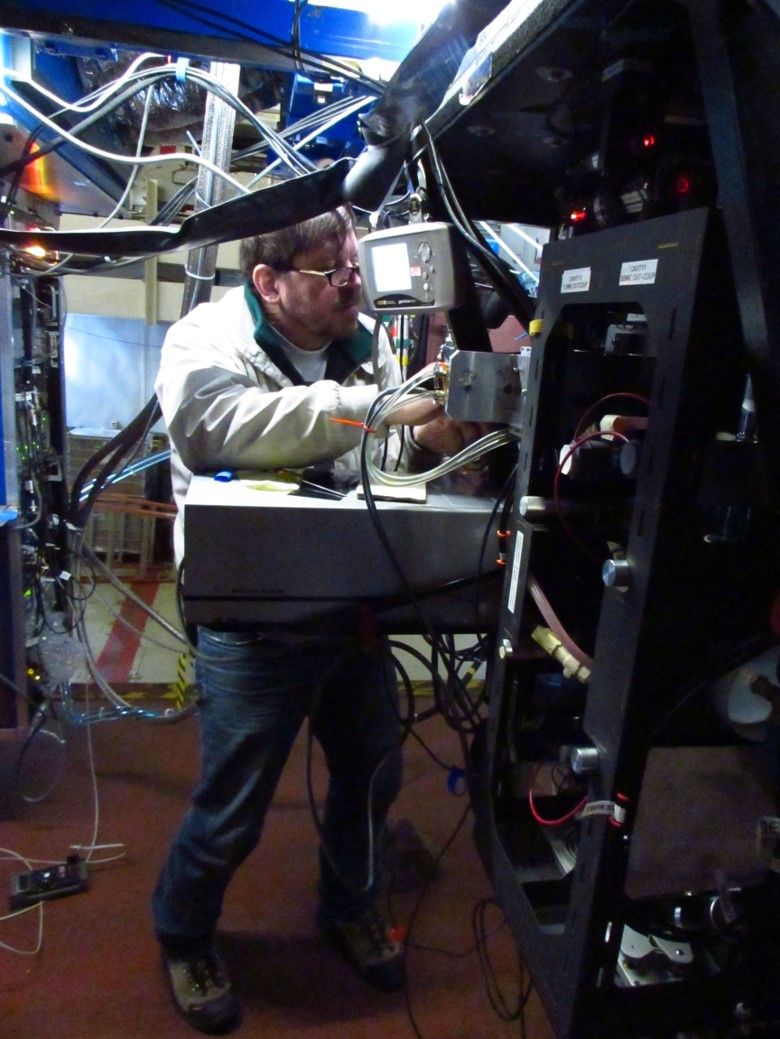
693 PI: Tim Livengood (UMCP), 693 Co-I: Ted Kostiuk (emeritus)
HIPWAC is the latest incarnation of infrared heterodyne spectroscopy (IRHS) technology at Goddard, beginning with work led by Theodor Kostiuk and Michael J. Mumma in the 1970's. The spectral power distribution of an infrared radiation source is measured from the distribution of beat frequency in the interference between the source beam and a frequency-stabilized laser used as a local oscillator. IRHS is used in the laboratory to measure molecular properties and at field observatories to measure emergent spectra from planetary atmospheres and astrophysical sources. HIPWAC features the greatest spectral resolving power in infrared astronomy, R > 1 million, which resolves natural pressure-broadened and/or Doppler-broadened molecular transitions, depending on the pressure regime probed in planetary environments.
IRHS instruments from Goddard have been used to demonstrate natural lasing of CO2 in the upper atmosphere of Mars and Venus, to measure trace hydrocarbon species probing outer planet atmospheres, to measure planetary winds in Venus, Jupiter, and Titan, and to investigate the photochemical water cycle on Mars expressed through transitions of ozone (O3). Recently, HIPWAC discovered evidence for diurnally varying abundance of isotopic CO2 in the atmosphere of Mars, implying exchange between the atmosphere and surface/subsurface reservoirs, a critical attribute to understanding the density of Mars' primordial atmosphere. HIPWAC is a visitor instrument at the NASA Infrared Telescope Facility on Mauna Kea. HIPWAC is charting the path for applications of IRHS sensing in flight missions, using miniaturized tunable laser systems as advanced local oscillators.
Submillimeter Enceladus Life Fundamentals Instrument (SELFI)
693 PI: Gordon Chin, 693 Co-Is: Carrie Anderson, Tim Livengood (UMCP)
Target Bodies
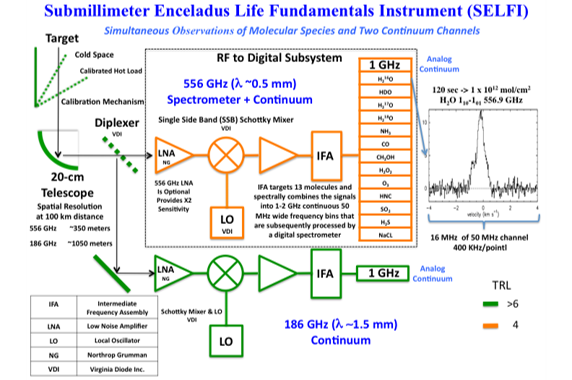
SELFI will remotely observe the chemical composition and dynamics of Enceladus' plumes Before, During, and After in situ plume encounters thus proving both context and targeting data for a sampling mission.
Key Capabilities
SELFI will advance four key technologies of the RF-to-digital Subsystem from TRL 4 to 6:
- RF low noise amplifier design from NGAS
- Single side band (SSB) mixer and LO from VDI
- IF Assembly down converter using MMIC elements
- Digital spectrometer using next generation FPGA
Key Advantages over State of the Art
- Simultaneous observations of H2O and its isotopologs plus ten other volatile species that are highly informative of Enceladus subsurface ocean
- Single-sideband receiver and LNA front-end improves sensitivity by X2 compared to SOA
- Digital spectrometer implementation holds promise for improved size, mass, and power
New Science Enabled
-
SELFI will simultaneously observe 14 molecular species that are important in the context of life and habitability of the Enceladus subsurface ocean
- Assess plume spatial/temporal compositional variability
- H2O, HDO, and δ18O, and δ17O clues to ocean evolution
- H2O2, and O3 oxidation state of the sub surface ocean
- SO2 and H2S links to pre-biotic molecules and volcanoes
-
Continuum observations measure surface temperature from 30 - 250 K
- Correlation of plume activity with surface temperature
Submillimeter Solar Observation Lunar Volatiles Experiment (SSOLVE)
693 PI: Tim Livengood (UMCP), 693 Co-Is: Carrie Anderson, Gordon Chin
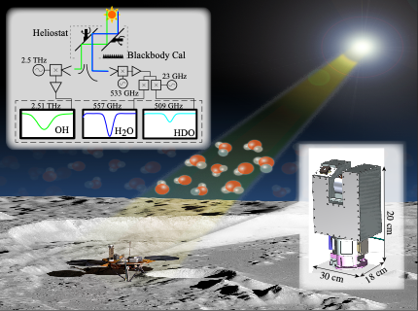
SSOLVE is being developed at Goddard for deployment on a lunar landed mission to measure the abundance of water vapor above the Moon's surface in its (extremely!) tenuous atmosphere. SSOLVE features a heliostat, an arrangement to maintain pointing its small telescope directly at the Sun as it moves across the lunar sky.
Receivers at 557 GHz and at 2.51 THz frequency will measure spectral absorption features of water (H2O) and its photolysis product, hydroxyl (OH), to measure even extremely tiny quantities as water vapor evolves from the surface and is broken into smaller components by solar ultraviolet radiation. Calibration measurements of an internal radiation source as well as neighboring lunar surface will evaluate the effects of contaminant water evolving from the lander's materials and from the landing process, to ensure distinguishing between site contamination and native lunar volatiles. The SSOLVE receivers and heliostat arise from Goddard's extensive legacy of flight-instrument development and microwave technology for Earth science.
SSOLVE is proposed for a 2024 lunar mission as part of the CORGIE instrument suite - Confirming Orbital Remote-sensing with Ground Investigation Experiments. The fundamental design of SSOLVE is suitable for future applications to landed platforms on other solid bodies throughout the Solar System, operating at suitable frequency range to measure relevant gases.
Wideband Imaging Submillimeter Heterodyne Spectrometer (WiSHeS)
693 PI: Gordon Chin, 693 Co-I: Carrie Anderson
Motivation
-
Submillimeter-wave spectral region is rich in molecular transitions indicative of potentially habitable environments
- H2O, H218O, H217O, H2O2, NH3, H2S, HDO, SO, SO2, OCS, 12CO, 13CO, ClO, HCl, ...
- Submillimeter spectroscopy is a powerful remote sensing tool that can be study numerous targets in the Solar System including our Earth and beyond
Project Objectives
- To establish a Goddard technology base and multidisciplinary expertise to build imaging spectrometers that far exceed current capabilities
- To revolutionize submillimeter spectroscopy and thrust Goddard to the forefront of discovery in Solar System exploration and Earth Sciences
Venus Wideband Submillimeter Heterodyne Spectrometer (V-WiSHeS)
693 PI: Carrie Anderson, 693 Co-Is: Gordon Chin, Tim Livengood (UMCP), Melissa Ugelow
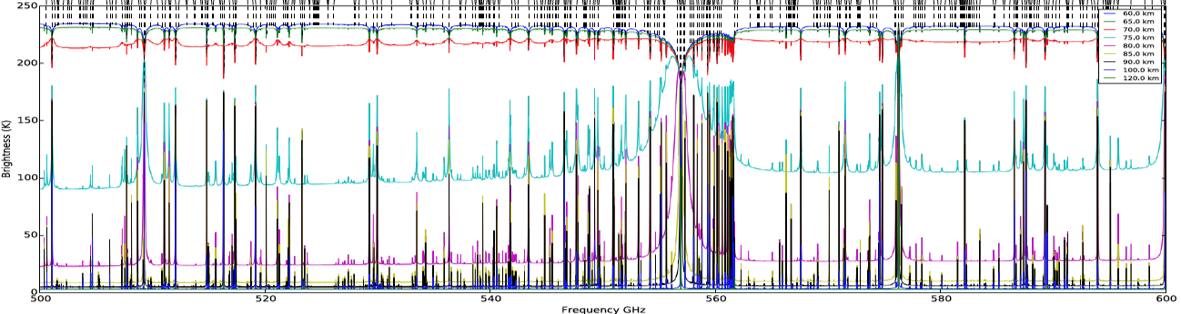
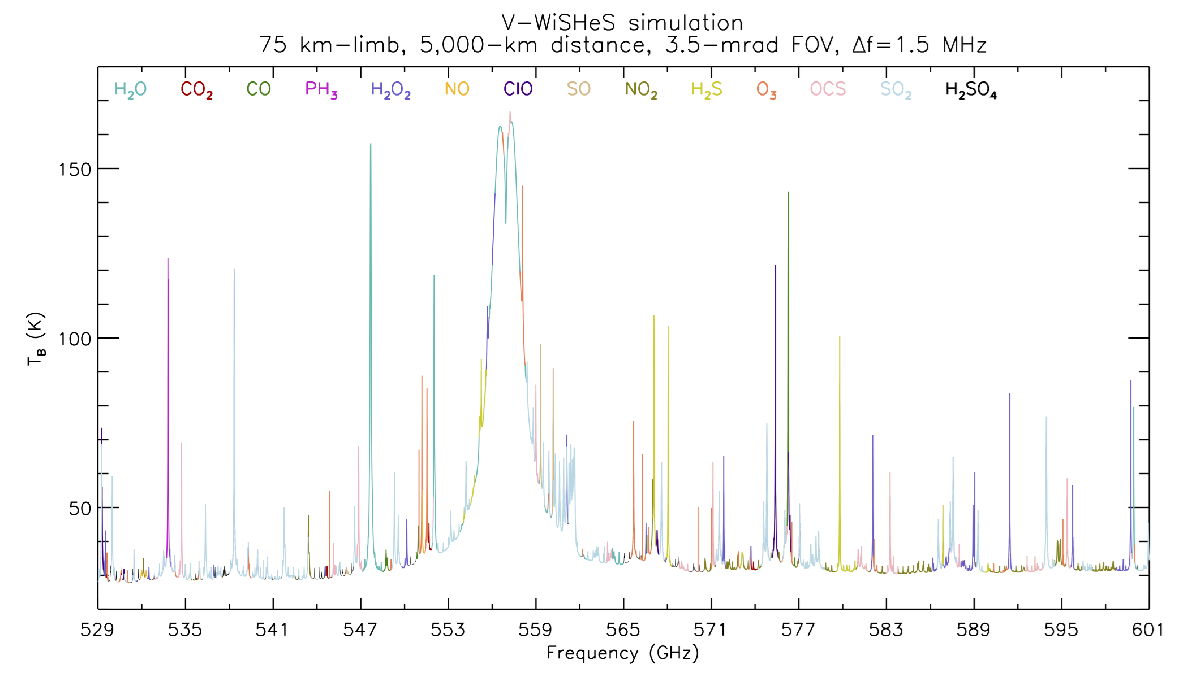
- V-WiSHes is a novel low-mass, low-power, and compact planetary flight submillimeter spectrometer (pending MatISSE) that achieves both high spectral resolution and a groundbreaking 64-GHz of broadband spectral coverage between 529 and 600 GHz
- V-WiSHeS' broadband coverage revolutionizes the present-day planetary flight heterodyne submillimeter spectrometers
- V-WiSHeS will investigate the chemical stability, along with the aerosol and dynamical structures, in Venus' middle atmosphere spanning altitudes 60 to 150 km (a simulated limb spectrum is shown to the right)
- V-WiSHeS measurements will answer fundamental, high-priority Venus atmospheric science questions that stem from both the current Planetary Science Decadal Survey and the 2014 NASA Planetary Science Plan
Ultra-Violet Detector Innovation for Raman Exploration and CharacTerization (UV-DIRECT) of Ocean Worlds
693 PI: Dina M. Bower (UMCP), 693 Co-Is: Shahid Aslam, Nicolas Gorius (CUA)
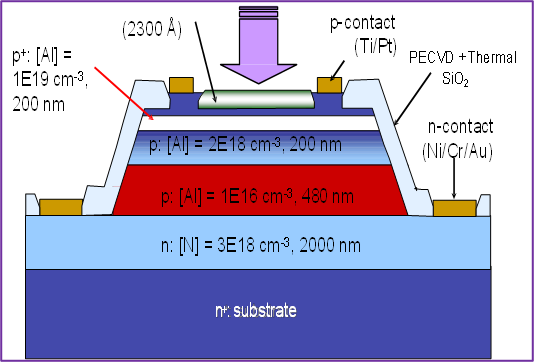
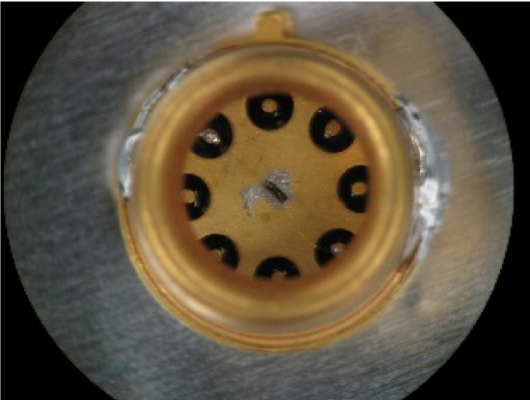
UV-DIRECT of Ocean Worlds enables the identification of minerals, volatiles, organic molecules, biopolymers, water, and other hydrous phases in planetary materials. UV-DIRECT utilizes a silicon-carbide (SiC) avalanche photodiode (APD), with high internal gain, specifically targeted for the identification of ocean world-relevant compounds utilizing UV/NUV (266-340 nm) Raman spectroscopy with ppb sensitivity. Excitation in the UV range permits the acquisition of Raman spectra without the signal-interfering fluorescence that is typical under higher wavelengths. SiC detectors are radiation hard and are also “blind” to visible light, i.e., solar background, that can completely obscure the Raman signal.
Unlike most mission-relevant Raman detectors that only support the acquisition of point spectra, the architecture of UV-DIRECT provides a path forward to facilitate Raman spectroscopic imaging. Acquiring point spectra can provide information about what compounds are present; Raman imaging enables the full characterization of target areas revealing spatial relationships between compounds, improving the capability of detecting biosignatures. For life detection this is important because while abundant in the solar system, the mere presence of organics does not indicate life, but the complexity of that material may be a biosignature. The SiC APD technology in UV-DIRECT is applicable for stand-off or in situ Raman applications, enabling compact, robust instrumentation for planetary surface exploration using Raman spectroscopy.