The article " Modeling atmospheric brown carbon in the GISS ModelE Earth system model" by Maggie DeLessio et al.. was voted the best research publication by the science staff of Goddard Institute for Space Studies to have been published in 2024. The paper appeared in Atmospheric Chemistry and Physics.
"For your significant contribution to our understanding of the evolution of, carbon sequestration in, and sedimentation in Hudson River marshes. Your passion as a mentor has led countless graduate students into scientific research.
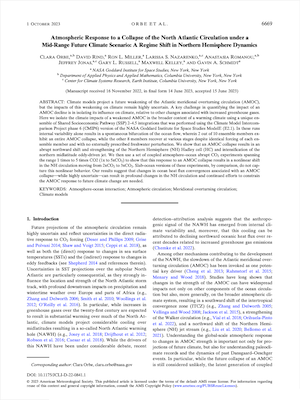
The article "Atmospheric response to a collapse of the North Atlantic circulation under a mid-range future climate scenario: A regime shift in Northern Hemisphere dynamics" by Clara Orbe et al.. was voted the best research publication by the science staff of Goddard Institute for Space Studies to have been published in 2023. The paper appeared in the Journal of Climate.
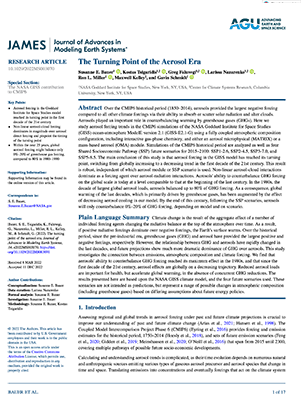
The article "The Turning Point of the Aerosol Era" by Susanne E. Bauer et al. was voted the best research publication by the science staff of Goddard Institute for Space Studies to have been published in 2022. The paper appeared in the Journal of Advances in Modeling Earth Sciences (JAMES).
Three SED scientists have been named 2022 fellows by the American Association for the Advancement of Science (AAAS) in recognition of their scientifically and socially distinguished achievements in the scientific enterprise.
"For her pioneering work in modeling the impact of climate change on food production worldwide. She was recognized for leading the global scientific collaboration that produced the methodology and data used by decision-makers around the world."
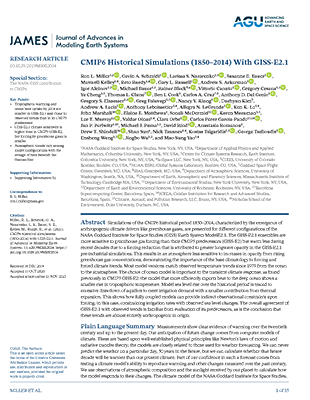
The article "CMIP6 historical simulations (1850-2014) with GISS-E2.1" by Ron Miller et al. was voted the best research publication by the science staff of Goddard Institute for Space Studies to have been published in 2021. The paper appeared in the Journal of Advances in Modeling Earth Sciences (JAMES).
The award is given in recognition of the four winners’ contribution to the understanding of climate change and related adaptation strategies. Dr. Braneon’s award was specifically for his contribution to understanding climate change impacts on urban, agriculture and natural systems as well as climate justice.
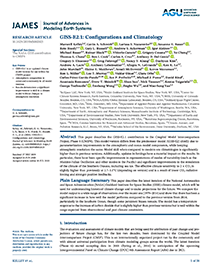
The article "GISS-E2.1: Configurations and climatology" by Max Kelley et al. was voted the best research publication by the science staff of Goddard Institute for Space Studies to have been published in 2020. The paper appeared in the Journal of Advances in Modeling Earth Sciences (JAMES).
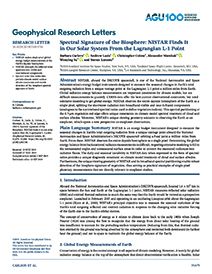
The article "Spectral signature of the biosphere: NISTAR finds it in our solar system from the Lagrangian L-1 point" by Barbara Carlson et al. was voted the best research publication by the science staff of Goddard Institute for Space Studies to have been published in 2019. The paper appeared in Geophysical Research Letters.
Presented by the International APOLO Project, this senior award is intended to celebrate profound contributions by a prominent scientist to the research field of polarimetric remote sensing.
As part of the Agency-wide Earth Science Partnerships Team for accomplishments in creating partnerships with commercial and non-governmental organizations.
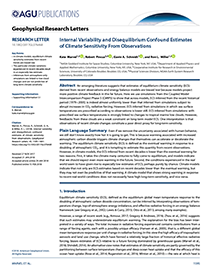
The article "Internal variability and disequilibrium confound estimates of climate sensitivity from observations" by Kate Marvel et al. was voted the best research publication by the staff of Goddard Institute for Space Studies to have been published in 2018. The paper appeared in journal Geophysical Research Letters.
Citation excerpt: "...For his unwavering dedication to the development and support of EdGCM and its effective use in teaching secondary and postsecondary students, Mark Chandler clearly deserves the AGU Excellence in Earth and Space Science Education Award."
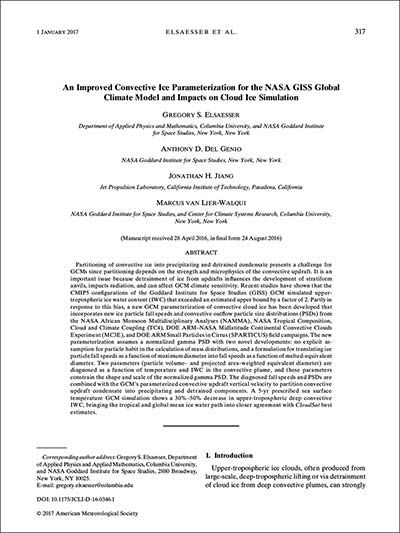
The article "An improved convective ice parameterization for the NASA GISS Global Climate Model and impacts on cloud ice simulation" by Gregory Elsaesser et al. was voted the best research publication by the staff of Goddard Institute for Space Studies to have been published in 2017. The paper appeared in the Journal of Climate.