What is your research focus?
As a computer scientist with the Community Coordinate Modeling Center (CCMC), my work spans a relatively wide variety of scientific domains. I research and implement methods for data validation and visualization of space weather phenomena, including solar wind, ionosphere plasma density, ground induced currents, and more. My main project at the CCMC is the Comprehensive Assessment of Models and Events using Library tools (CAMEL) framework. The CAMEL web app contains arithmetic skill scores for evaluating models, graphs for visualizing multi-model comparison, and maps to display model data availability over time. Each page of the CAMEL website is tailored to the study it displays, so I am constantly learning more about the intricacies of space weather. I greatly enjoy getting to play jack-of-all-trades when it comes to scientific phenomena.
As the lead developer on CAMEL, my goal is to ensure the entire space weather field, from domain scientists to model developers to program officials, has the capability to create, analyze, and improve models. I work on the data analysis process from beginning to end. This includes cleaning and formatting the initial data files, creating and maintaining efficient databases, writing postprocessing scripts, and designing an interactive website for users to access. CAMEL is also always expanding, so I add updated models to the database, speed up metric calculations, create new visualization formats, and incorporate any other user feedback. As a NASA Open Science framework, CAMEL is a very collaborative project and am constantly in communication with scientists to ensure our software is meeting their needs.

Poster presentation on the CAMEL web application at AGU 2024.
How did you end up working at NASA Goddard?
During my freshman year of college, my roommate’s sister told me about an internship opportunity she thought I would appreciate: NASA’s Student Airborne Research Program (SARP). The only problem was that the program was meant for rising college seniors, so I put the application date in my calendar for spring semester junior year, at that time a full two years away. I continued my studies in computer science, math, and environmental science, and when the deadline rolled around, I applied and was accepted to SARP.
SARP was a transformative experience for me. The program, based out of Armstrong Flight Research Center (AFRC), brings together students from across the country to participate in the airborne campaign and complete an individual research project using SARP data. Over the course of eight weeks I flew on the DC-8 collecting whole air samples, analyzed sample canisters in the lab, created models to investigate each separate influence on atmospheric gas concentrations, and presented on the seasonal variation of methane concentrations in Southern California. My research demonstrated that the temperature dependence of methane emissions from dairy farms is a significant aspect of the seasonality of methane concentrations, even given all the other contributing factors. Throughout the program, I met so many NASA scientists, engineers, and educators and was exposed to many new ideas and opportunities. SARP expanded my understanding of Earth sciences, encouraged me to continue developing data and computer skills, and gave me my first taste of what it’s like to work at NASA.
The following year, when I was applying to jobs for after graduation, I knew that my goal was finding a way to utilize my coding expertise for scientific progress. Thanks to SARP, I knew that working for NASA was a way to do that; if I didn’t possess the specific domain knowledge, I would learn it from colleagues and mentors. I had never heard of space weather before I applied to my current position but was drawn to the team dynamic and commitment to scientific progress.
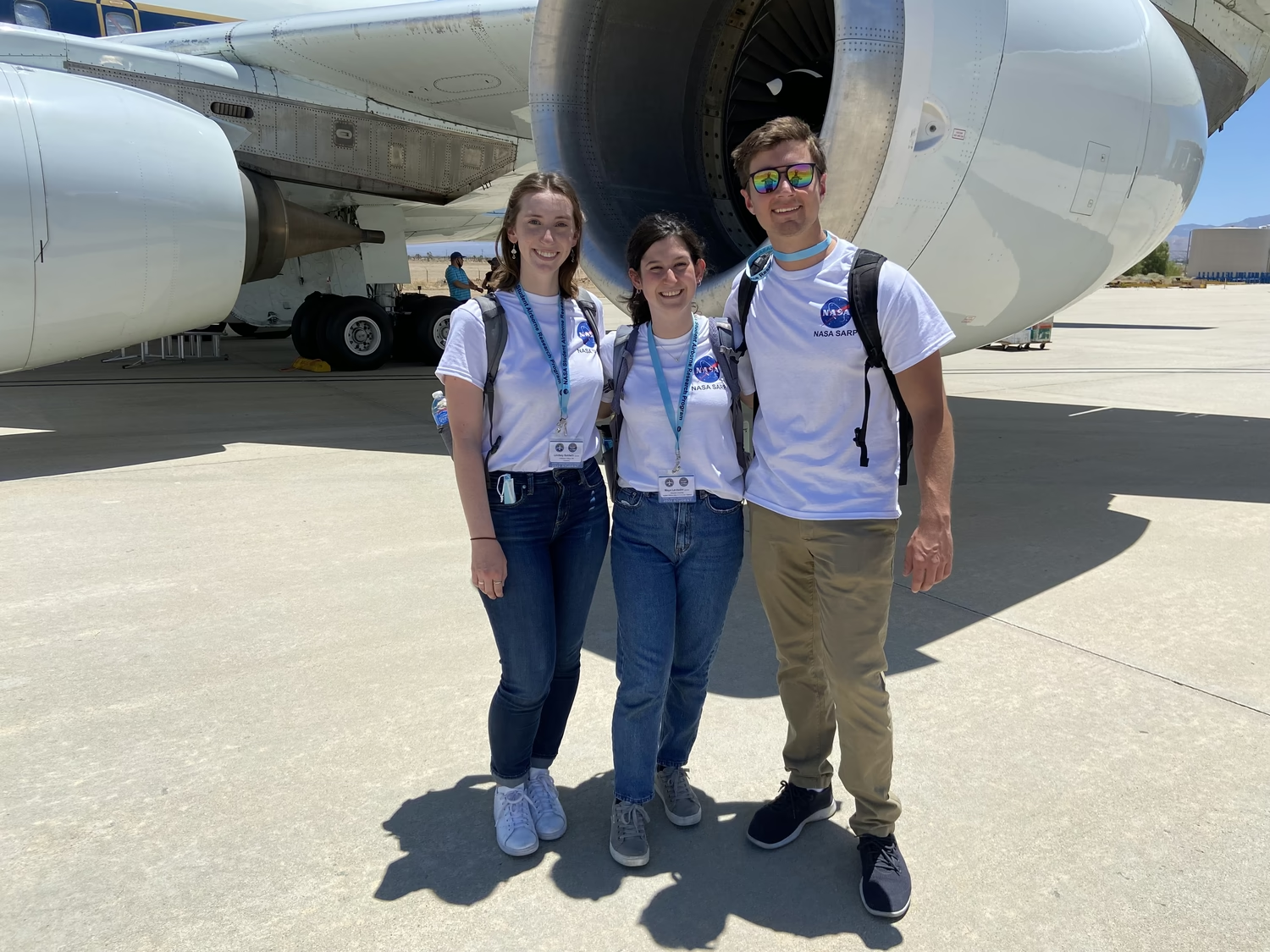
With friends in front of the NASA DC-8 on the SARP airborne campaign.
What scientific challenge intrigues you the most?
Right now, it feels impossible for me to read an article or scroll through LinkedIn without seeing people argue about AI. I wrote my senior thesis on machine learning so the world of AI/ML is not new to me, and it is clear the conversations have changed in the last few years. As artificial intelligence software improves and expands its reach, I often think about how we can learn to use the technology responsibly. For example, how do we weigh the benefits of improving high performance climate modeling capabilities and the climate impact of data centers and supercomputing hardware? Is it possible to find this balance? The growth of AI brings up many other environmental considerations as well as questions of intellectual property, social responsibility, and more. I am intentional about using other tools before turning to AI assistance, which is a small mindset shift but easily avoids irresponsible or overuse. The explosion of LLMs has transformed the way people use the internet but, as is the nature of LLMs, all the information provided was already accessible online; you just have to know where to look. With a career in software, the challenge of responsible technological development is part of almost everything I do and I can’t ignore the implications of the industry.
What skills are most useful to you in your work, and where did you develop those skills?
One of the most important skills I utilize when I’m coding is creativity. When I’m writing software, there are often many solutions to the problem at hand and some will be more elegant than others. There are unintended consequences that create a new issue from solving the first. The most obvious path is not necessarily the best, so finding creative ways to implement solutions and fix bugs is incredibly important to my work. I credit teachers starting as young as elementary school with showing me how to be curious about the world and think outside the box.
I also try to implement creativity outside of work through hobbies such as crafting, baking, and rock climbing. I joined a bouldering gym in college as a fun way to exercise that also practices creativity and problem solving. On a bouldering wall, there are multiple routes to get to the top and different climbers will find routes that play to their own strengths. Being able to find new moves and try different routes is key to being a good climber.
What keeps you inspired by your work?
I try to remember how hard I worked to get to where I am now, and how proud it would make a younger version of myself. I also sometimes take a break to learn about other work happening at NASA, whether online or by wandering the halls. My team recently moved to Building 28 and I have been so inspired by exploring the different mission offices, meeting people at lunchtime, and seeing projects displayed on the hyperwall in the atrium. I love getting to hear about new projects and find that it can help me see my own work from a new perspective.

Presenting to my high school’s Women in STEM club.
If you were to expand your current research focus, what new topic(s) would you explore?
I have loved getting to use software to better understand space weather and I would enjoy getting to include Earth science and climate systems as well. I have learned so much about data and modeling since my last role and it would be cool to apply those new skills to domains that I’m already so familiar with. Data visualization and validation are relevant and necessary in so many fields that there are countless ways to expand my focus, so I’d like to return to the topics that initially sparked my interest in environment and climate. I’m actually in the process of transitioning to a new role within the Science Mission Directorate and will be working at the Goddard Earth Sciences Data and Information Services Center (GES DISC). As one of NASA's Distributed Active Archive Centers (DAACs), GES DISC provides access to wide variety of Earth science data and analysis tools.
In fact, some of the data that I work with in space weather domains comes from satellites that predominantly provide Earth observations, such as GRACE-FO and ICESat-2. As I continue working with similar datasets, I’m interested in research that looks at all the instrument data available from a certain satellite, regardless of domain or purpose. Looking at visualization and validation trends across larger datasets and using satellite data for an interdisciplinary approach would surely provide new insight and is something I’d like to explore.
Tell us about a unique or interesting component of your work-life balance.
I am a sabbath-observant Jew, so from sundown Friday night to Saturday night I do not do any work. I don’t complete any tasks related to my job, but the Jewish sabbath (shabbat) also includes other forms of work. I do not drive, cook, make purchases, or turn electronics on or off. Food is prepared, spaces are cleaned, and lights are set before the sun sets on Friday. For 25 hours I do not use my phone, watch TV, or open my laptop. Shabbat is an incredibly meaningful part of my religious life and also a built-in break from work every week. My coworkers know that every Saturday I will be fully offline and unreachable (except in cases of emergency). Many people assume that observing shabbat is oppressive or difficult, but in reality it creates a consistent schedule for work-life balance. It just takes a little bit of preparation to craft an intentional 25-hour period of calm. Shabbat makes space for rest, human connection, slowing down, and it’s usually one of the best parts of my week.

Exploring Panama with my fiancé, Zach.
Published Date: .
Hometown:
Newton, MA
Undergraduate Degrees:
B.S. Applied Mathematics, Brandeis University, Waltham, MA
B.S. Computer Science, Brandeis University, Waltham, MA