

What inspired you to pursue a career in optical oceanography?
My career sometimes feels like hopping across a huge river on stepping stones. When I started college, I was one of those students who struggled to settle on a major, so I went with a vague “maybe biology?” and took literally every introductory science course I could. In the second semester of my first year, I took an introduction to physical geography class and had my first “lightning strike” moment: “Wait, geography can connect to almost any science if I add the question ‘where?’” Around that time, a new meteorology major had just been created in the geography department, so I signed up with plans to study climate change. How is it happening? Why does it vary from place to place? Which regions might be most affected? It felt like an existential threat, and I wanted to be part of the “all hands on deck” effort to study it. Though, as I was getting closer to graduating, I couldn’t decide whether I wanted to go into glaciology or oceanography as my next science rock to hop to. I was incredibly fortunate enough to be able to participate in NASA’s Student Airborne Research Program as a summer research experience in Southern California, where we’d be flying in a dedicated research plane collecting measurements to start and finish a research project and present it by the end of two months. We were split into teams working on atmospheric chemistry, land remote sensing, or ocean remote sensing. I was placed in the ocean group, and I fell in love with doing math with colors and using the mix of blues and greens quantitatively to characterize how the oceans were changing over time. I had taken remote sensing classes before, but until then I had only used the ocean as a sort of dark background measurement to help take out the atmospheric effects on satellite images. Once I was able to see what dedicated ocean color sensors could capture, that dark ocean target turned into a whole new world of swirling blues and greens, where a single image could tell us so much about the physics, chemistry, and biology of the ocean. There was so much work to do, and so I became an optical oceanographer.

Going out to the field is hard work! This was on the North Atlantic Aerosols and Marine Ecosystems Study (NAAMES) field campaign in Spring to measure part of the huge seasonal phytoplankton bloom. This was not a day for measuring optics though.
What scientific challenge intrigues you the most?
This might sound a bit odd, but I’m so curious about how much information is hidden in the “fuzziness” of a data point! Most people would think of it as uncertainty or error bars. Over time, we’ve developed amazing algorithms and models based on inputs from equally fantastic instruments that have been deployed both in the field by scientists in the remotest reaches of the Earth or launched towards the stars to observe from above. However, every step in this process has some sort of uncertainty attached to it. For example, to get something like how much chlorophyll-a is in the ocean from satellite observations, we’re not measuring chlorophyll directly. We’re measuring sunlight after it has interacted with the atmosphere (like clouds, aerosols, and trace gases), and the ocean surface (like waves, bubbles, and sea foam) and then trying to infer what’s happening in the water by taking ratios of the magnitude of the remaining blue and green light and running it through an algorithm made to link these light values to that chlorophyll concentration. The result depends on the viewing geometry (the angles between the sun, the ocean, and the sensor), on the assumptions built into the model, and on how well this method has been validated using field measurements. I’m interested in following these uncertainties from beginning to end, not only their size at each step, but how they change across locations, seasons, and environmental conditions, plus how these different uncertainties are linked to each other. If we can do this well, we’d get a pretty powerful diagnostic tool. We can home in on what parts of the algorithm matter the most for each variable, where it might be fragile, and what new measurements would improve it the most. The problem is that this quickly becomes incredibly complicated for even the “simple” products. It requires an audit of the assumptions that have gone into each component of an algorithm as well as some clever math to track the uncertainty through each step, plus it needs a lot of computing power to work through it. I’m excited about the use of machine learning to help us speed things up, and I think there’s so much potential for making huge advances in what we know in the near future!

Yes, we even measure ocean color at night! In addition to radiometers which track how the sunlight is changing in the water column, we also have special sensors that measure how much light gets absorbed and scattered with their own lights. No sun needed!
Tell us about the research projects you are currently working on.
My primary research project right now asks a simple question: How much better can we do if we combine different kinds of satellite observations instead of relying on one instrument at a time? A major step in ocean remote sensing is atmospheric correction, which removes the atmosphere’s contribution to the signal, so the remaining information reflects the ocean itself. This requires extra inputs like atmospheric pressure or water vapor content, which typically comes from outside sources like global models or climatological values. NASA’s <a href='https://science.gsfc.nasa.gov/earth/projects/42/ target='_blank'>Terra satellite gives us the perfect test case because it has two instruments that complement each other. One of them, the Moderate Resolution Imaging Spectroradiometer (MODIS), measures reflected sunlight in several distinct color bands (we would typically call this a “multispectral” sensor), including the blue and green wavelengths that ocean scientists use to estimate things like chlorophyll. We can already think about this intuitively: does the ocean look more green than blue? Then it probably has more chlorophyll in the water! We’ve just attached numbers to the specific levels of blues and greens and attached them to specific concentrations of chlorophyll. The drawback is that Terra was designed with strong land observing goals in mind, so the way it is tilted can make the glare from the sun reflecting off the water, called sunglint, more of a problem, so we typically cut these data from our analysis. But Terra also has the Multi-angle Imaging SpectroRadiometer (MISR) sensor, which views the same location from different angles as the satellite passes overhead. This is super useful for figuring out what the atmosphere is doing, like what is the amount and type of tiny airborne particles called aerosols in a region, and those extra angles can help us get around the sunglint areas! My goal here is to quantify just how much information those extra viewing angles provide and how that improvement carries through to ocean color products. To do this, I use a statistical approach called Bayesian inference, which lets me combine data with prior knowledge and explicitly track uncertainty. This requires many, many simulations using a method called Markov Chain Monte Carlo (MCMC) to get a whole range of possible combinations of answers rather than just one “best” answer. I compare what we can retrieve using MODIS alone, and then I see what happens when I hammer the MODIS observations together with MISR. If my range of possible answers goes down, that means I’m more confident about what answers do remain, and the uncertainty has gone down. My hope is that this turns into a workflow for combining retrievals to really utilize every instrument’s strengths, and to be explicit about what we do and do not know.
I’m also involved in validation work for NASA’s Plankton, Aerosol, Cloud, ocean Ecosystem (PACE) mission! A huge stream of field measurements (plus their uncertainty!) is coming in from NASA-funded researchers from the PACE Postlaunch Airborne eXperiment (PACE-PAX) and PACE Validation Science Team (PVST) campaigns as well as external long-term observing networks like the AErosol RObotic NETwork (AERONET) and AERONET ocean color (AERONET-OC), which then goes through many subject matter experts who quality control the data. My role is to take the ocean portion of this data, match it up against corresponding PACE observations, and then bundle it together to send to the validation leads for the mission. Because I’m at this step of the process, I get to see how the uncertainty flows top-down from the satellite measurements and bottom-up from the field observations. It’s also given me the chance to explore how we define a “matchup”. Some field matchups get labeled invalid because they’re a little too far away from the satellite pixel or slightly offset in time from the overpass, but these differences might not matter much for some ocean variables depending on their location. Since the field teams are estimating spatial and timing uncertainties explicitly, I think we can reevaluate these matchup rules and make them more flexible so we can get more value out of this hard-won field data and really test what our satellites are capable of!

Most instruments are attached to special ship cranes which are operated in a control room inside the ship. Our radiometers are hand-deployed, which can really be a workout! This was one of the relatively rare good sea states for optics in the North Atlantic, so we took advantage of it and deployed even though it was overcast. There’s still light to measure! I don’t look tired enough in this photo so I’m sure it was pre-cast.
What is one of your favorite moments in your career so far?
When I was in grad school, I was really struggling on my third chapter of my thesis, which was the one I was the most excited about. I was trying to build a bio-optical algorithm that could estimate the size distribution of different kinds of particles in seawater by using both absorption (how much light the particles take up) and backscattering (how much light they redirect back towards a sensor). The physics I was using comes from Lorenz-Mie theory, which describes how particles scatter light depending on their size and composition. Before this, most particle size distribution algorithms using either absorption or scattering alone often treated all particles as one bulk group. I wanted to separate particles associated with phytoplankton from other material and estimate each of their size distributions more directly, but I couldn’t get the math to behave. So, I put everything I had done so far on a poster and went to present it at the Ocean Sciences Conference that year hoping someone would see what I was missing.
When my poster time slot came up on the first day of the conference, I got to show it to some of the leading experts in my field, but most of the feedback was some variation of “this is too hard for one chapter” or “this probably won’t work” which was pretty devastating to hear to say the least. I spent the next few days going to all these awesome conference talks as a kind of distraction while trying to make a Plan B for the chapter in the back of my head. I got to hang out with a bunch of other grad students in very different fields as a social event, and we were all bonding over life in grad school, when a few of them heard what I was attempting and were curious about my problem. So, I went through my poster spiel, and they asked great questions and offered so many good suggestions, giving thoughts on how they might approach it using methods in their own disciplines since they hadn’t had much experience with optics. It was such an amazing change of pace, and it really reinforced the idea that our science is so deeply interdisciplinary that if we ever get too caught up in the weeds, we can always take a step back and hang out with friends and colleagues in different areas. A fresh perspective can reveal a path we couldn’t see when we were locked into one way of thinking, and it’s super easy to be that fresh perspective for them as well.
Thanks to them, restructuring my model ended up making the math work out, and now I have an algorithm that is getting incorporated into the PACE mission!
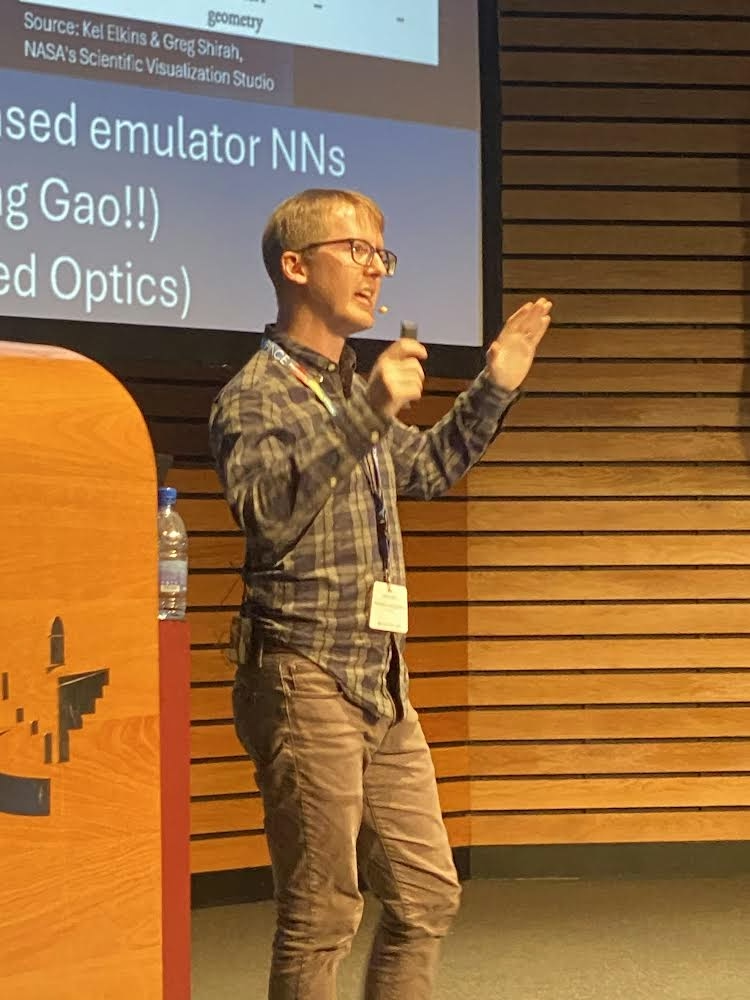
I love getting up and talking in front of people, but I had always given poster talks at science conferences. My first oral presentation was at the Ocean Optics Conference in October 2024. I was pretty nervous about it, so I slipped in puns about MCMC Hammer and incorporated a Bayesian inference dance into my presentation.
What do you enjoy the most about your job?
I love that I’m surrounded by so many world-leading experts and that they’re so relentlessly curious and genuinely want others to succeed. We’re all working together to push our missions to their highest potential, and it’s so amazing to be able to lean on each other for support. I’ve lost count of how many times I’ve hit a snag or confusing part in my research, and someone down the hall already has a published paper going over it or has written a half dozen codes and is more than happy to send it along so I can better understand and answer my own research questions. I also love the cross-pollination. There’s such a wide range of expertise that ideas travel in surprising directions. For example, I’ve been able to incorporate workflows that astrophysicists use to study galaxy formation for my own ocean remote sensing. And I’ve even had the chance to help out with modeling cosmic dust in our solar system with my own ocean particle models, which sounds like a big stretch until you realize that in both cases, we’re just trying to infer the properties of tiny particles from the way they interact with light!

The not-so-well-kept secret for field work at sea is that the vast majority of your time will be spent watching water drip. This is one of many seawater filtering setups, and it was put together specifically to keep the filtered water to measure colored dissolved organic matter (CDOM). If you think of phytoplankton as the tea leaves, CDOM would be the tea itself. Other filter rigs are built to just keep what remains on the filter itself, which promptly gets flash-frozen in liquid nitrogen or stored in a fridge depending on what type of sample it is.
If you were to expand your current research focus, what new topic(s) would you explore?
So far, most of my ocean color work has focused on light intensity, where I’m looking at how much light is absorbed or scattered or reflected at each wavelength and in which direction. But light also has another kind of information: polarization. This basically describes the orientation of a light wave as it travels. Back in science classes, we usually learn to think about light in terms of color and wavelength, where red light has a longer wavelength and blue light has a shorter one. But this only tells a part of the story. Even if two beams of light are the same color, the waves can still be oriented differently. If light is unpolarized, those orientations are all mixed together in a chaotic jumble of spaghetti, going up-down, side-to-side, one diagonal to the other, or even curling in a circle! But when light reflects off a surface or scatters off particles, this jumble can get partly “combed out”, so some wave orientations become more common than others. A fun example of this is sunlight reflecting off water. That bright glare is often strongly polarized which is why those fancy sunglasses work so well for fishing or boating. They filter out most of that glare by blocking one preferred orientation of the reflected light, which makes it easier to see into the water. That’s what makes polarization so exciting scientifically: it gives us extra clues. When light bounces off the ocean surface, travels through the atmosphere, or scatters off particles, its polarization can change in ways that depend on the angles involved as well as the size, shape, and composition of whatever it interacted with. So, polarization gives us another layer of information about what the light has encountered before it reaches a sensor.
The PACE mission’s main sensor, the Ocean Color Instrument (OCI), is hyperspectral; it measures light in many very narrow color bands, which gives us a much more detailed view of ocean color than older multispectral instruments, and researchers are doing some amazing things with them! But PACE also has two additional sensors, the Spectro-polarimeter for Planetary Exploration (SPEXone) and the Hyper-Angular Rainbow Polarimeter (HARP2), that can measure polarization as well as intensity. So, they can tell us how bright the reflected light is as well as how the orientation of that light changed after interacting with the atmosphere and ocean. To me, it’s a whole new dimension of information to play with; it can help us disentangle what the atmosphere is doing from what the ocean is doing and potentially tell us more about particles in the air and in the water at the same time. I’m really interested in how the ocean surface and phytoplankton affect polarization and whether we can use that signal to characterize the ocean in new ways. I have the exact same feeling as I did in undergrad when the world of ocean color first opened up to me, and I’m really excited for where the next stepping stones will take me!

James attempts to teach young minds in Nara, Japan about the merits of uncertainties, but fears they were only there for the seminar snacks.
What is a fun fact about you?
I took dance lessons for over ten years growing up and even competed nationally for some of them! My favorite was tap, followed closely by ballet, but I also did jazz and even acrobatics for one (very scary) year. I was a pretty bouncy child, and dance was how I was able to channel my energy into something (hopefully) a bit more graceful. Do I still look like a goober at parties on the dance floor? Absolutely. I don’t think any number of dance classes will be able to fix that!
Published Date: .
Hometown:
Memphis, TN
Undergraduate Degree:
Bachelor of Science in Meteorology with a specialization in GIS at the University of Tennessee at Martin, Martin, TN
Post-graduate Degree:
Ph.D. in Marine Science, University of California, Santa Barbara, Santa Barbara, CA