Program & Topics

Five days. Five tracks. One mission.

Planned workshop topics and sessions for the five-day workshop at NASA Goddard Space Flight Center.

Download full agenda (PDF)


wb_sunny expand_more

Day 1 - Space Weather Enabling Exploration (Day 1 details)

The Current Landscape: Agency Updates & Major Milestones

This opening session sets the stage with programmatic, high-level updates on current architectures, recent mission outcomes, and strategic goals. This opening session provides a comprehensive update on the Moon to Mars Architecture and the Artemis program. It will highlight recent successes (such as Artemis II science outcomes) and outline the roadmap ahead.


Defining the Gaps: Operational & Agency Needs for Deep Space

As human exploration, along with technological infrastructure, extends beyond Low Earth Orbit (LEO), operational requirements for space weather forecasting and radiation mitigation become more stringent. This session focuses on setting the stage in this workshop for identifying current gaps in predictive capabilities, instrumentation, and real-time support.


Cross-Agency Perspectives & Future Collaborative Solutions

As NASA establishes a sustained human presence on the Moon and looks toward Mars, space weather becomes a critical operational challenge. This session features perspectives from different NASA directorates and agencies (e.g., NASA, NOAA, ESA) about how to unify efforts for sustained lunar and Martian exploration. This session will bring together different viewpoints to discuss how to tackle future challenges collaboratively, building a resilient and interoperable space weather network that directly supports deep space human and robotic exploration, and unifying efforts for sustained lunar and Martian exploration.


S2X2S (Science to Exploration to Science) - Bridging the Gap

With the successful integration of science objectives within Artemis II mission operations through a console position within Mission Control, the connection between Science and Exploration is stronger than ever. This session explores the two-way street of S2X2S, highlighting how operational experiences inform future research and discussing the exciting new scientific opportunities that will emerge from upcoming exploration activities.


rocket_launch expand_more

Day 2 - Safeguarding Lunar Infrastructure: Science, Observations and Predictive Capabilities (Day 2 details)

Lunar Infrastructure, Science, and Exploration Activities

As NASA and its partners transition from brief lunar visits to establishing a sustained habitat, understanding the interaction between space weather, the lunar environment, and the infrastructure supporting exploration is critical. This session will provide an overview of the lunar space environment, reviewing known and unknown science as well as the impacts of space radiation and plasma on spacecraft hardware, space suits, and surface infrastructure.


Observations and Modeling Capabilities for Lunar Exploration

To safely execute exploration activities highlighted in the previous session, operators will require robust, real-time observational data and highly accurate predictive models. This session focusses on the current state and future needs of (cis)lunar space weather monitoring. This session will overview the deployment of new observational assets, leveraging the utility of existing missions for lunar exploration, and the latest modeling efforts to advance operational forecasting tools for mission planning and real-time decision-making.


satellite_alt expand_more

Day 3 - Mars Exploration: Infrastructure, Science, Observations and Modeling (Day 3 details)

Mars Infrastructure, Science, and Exploration Activities

As NASA continues to support interplanetary exploration to Mars and advance plans for a human mission to the Red Planet, it is essential to understand the Mars environment and its interactions/coupling with solar and heliospheric activity. This session will provide an overview of the Mars environment, reviewing known and unknown science as well as potential hazards for exploration including radiation, variable atmospheric conditions, dust storms, and radar blackouts. The impacts of space radiation and plasma on spacecraft hardware, space suits, and surface infrastructure.


Observations and Modeling Capabilities for Mars Exploration

To safely execute exploration activities highlighted in the previous session, operators will require robust, real-time observational data and highly accurate predictive models. This session focusses on the current state and future needs of Mars space weather monitoring. This session will overview concepts for new observational assets (e.g., Mars-L1 mission), highlight the utility of existing missions at Mars, and share updates about the latest modeling efforts to advance operational forecasting tools for mission planning and real-time decision-making.


public expand_more

Day 4 - Space Weather Impacts on NASA Missions: Operational Constraints, Tools, and Hazard Mitigation (Day 4 details)
Overview of SWx Impacts and Mitigation Strategies for NASA Missions

This session provides an overview of how space weather affects NASA missions and infrastructure, highlighting real-world impacts from radiation, geomagnetic activity, and spacecraft charging, along with lessons learned from commercial activities.


SWx Constraints for NASA special operations

This session explores how space weather constrains critical NASA operations such as launches, EVAs, and spacecraft maneuvers, drawing on lessons from missions like ESCAPADE, IMAP, and the James Webb Space Telescope. It also focuses on decision-making under risk, mission-specific support needs, and how operational experience informs go/no-go criteria and planning.


Data, Models, Tools, and Resources for Mission Support and Anomaly Characterization

This session highlights the current data, models, and tools used to support mission operations and characterize space-weather related anomalies originating from environmental effects like radiation, atmospheric drag, and signal disturbances.


SWx Impact on Debris, Meteoroids, and Dust

This session examines how space weather influences debris, meteoroids, and dust risks to spacecraft and mission support, including collision avoidance activities, anomaly resolution for the International Space Station, and dust mitigation efforts for Artemis as well as other exploration activities.


groups expand_more

Parallel Session Day 4 - A Day in the Life of a Space Weather Analyst (Parallel session details)

Day with a Space Weather Analyst

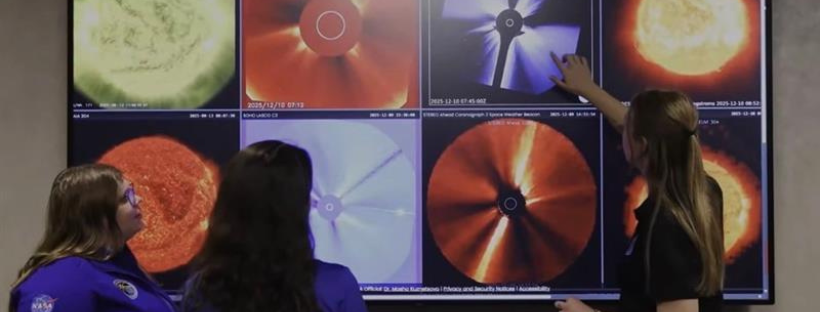
M2M SWAO’s space weather analysts will offer a special 1-day session. This “Day with a Space Weather Analyst” will include hands-on space weather scenarios where participants can interface with the real-time space weather analysis processes and tools used by M2M SWAO to assess and predict space weather throughout the solar system. A basic background on space weather is suggested, but not required. Limited seats are available for this session, so please indicate your intent to participate in the registration form.


Sign up here

groups expand_more

Day 5 - The Future of Space Weather Prediction Capabilities (Day 5 details)

The Future of Space Weather Prediction Capabilities

This session will present ongoing initiatives to advance space weather knowledge and predictive capabilities in support of NASA space exploration. These highlighted activities will identify successes, challenges, and opportunities for the next generation of space weather prediction capabilities in the context of development, testing, and validation through the lens of the research to operations to research (R2O2R) framework.


View the full daily schedule

All five days at a glance — sessions, speakers, and times.

rocket_launch Join the Mission

Ready to participate?

Registration is now closed. The workshop will be held in person at NASA GSFC, with a virtual option for select activities.

Registration Closed Back to Home