
14th Space Exploration & Space Weather Workshop
June 22–26, 2026 · NASA Goddard Space Flight Center, Greenbelt, MD
Building 34, Room 150
Navigating the Space Between Worlds
Understanding our star. Enabling our future.
The NASA Space Exploration and Space Weather Workshop brings together agency personnel and invited collaborators to advance space weather knowledge and predictive capabilities in support of NASA space exploration. The workshop is hosted and coordinated by the Moon to Mars Space Weather Analysis Office (M2M SWAO) within the Heliophysics Science Division at NASA Goddard Space Flight Center (GSFC).
This five-day workshop highlights ongoing scientific, operational, and exploration activities supporting NASA’s Artemis program and Moon to Mars Architecture to identify and understand the impacts of space weather. The workshop will be held in person at GSFC with a virtual option for remote participation in select activities.
For NASA personnel and invited collaborators.
Workshop Highlights

Day 1 - Space Weather Enabling Exploration
NASA strategic foundation for the Moon to Mars architecture. Artemis updates and identifying critical operational gaps. Discussions will highlight cross-agency collaborations and the vital two-way street between science and exploration.

Day 2 - Safeguarding Lunar Infrastructure: Science, Observations and Predictive Capabilities
Operational vulnerabilities of establishing a sustained human presence on the Moon, including radiation impacts on surface infrastructure and spacesuits. Critical observational networks, predictive models, and R2O2R pipelines required to safely execute these lunar missions.

Day 3 - Mars Exploration: Infrastructure, Science, Observations and Modeling
Space Weather impacts of the Martian space environment translated into the operational realities, environmental hazards, and vulnerabilities of future human and robotic missions to Mars. Critical observational networks, conceptual missions like Mars-L1, and the advanced predictive models required to safely execute these interplanetary missions

Day 4 - Space Weather Impacts on NASA Missions: Operational Constraints, Tools, and Hazard Mitigation
Space weather constrains critical NASA operations. Real-world mitigation strategies, go/no-go decision-making process, specific tools used for anomaly characterization and managing physical hazards like orbital debris, meteoroids, and dust.
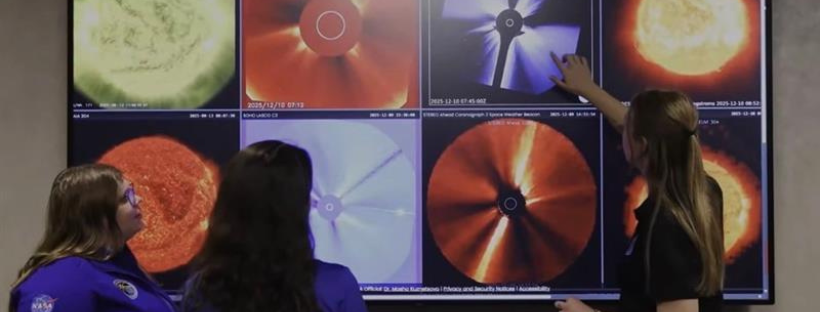
Day 4 - Parallel Session - A Day in the Life of an Analyst
This parallel session include hands-on space weather scenarios where participants can interface with the real-time space weather analysis processes and tools used by M2M SWAO to assess and predict space weather throughout the solar system.

Day 5 - The Future of Space Weather Prediction Capabilities
Ongoing initiatives to advance the next generation of space weather prediction capabilities in support of NASA exploration. Discussions will identify successes, challenges, and future opportunities for model development and validation through the R2O2R framework.
At a Glance
Day 1 — Space Weather Enabling Exploration
Agency updates, Moon to Mars architecture, cross-agency perspectives, and S2X2S bridging.
Day 2 — Safeguarding Lunar Infrastructure
Lunar environment, radiation impacts, and observation/modeling capabilities for sustained presence.
Day 3 — Mars Exploration
Mars environment, weather forecasting, climate modeling, and observations supporting interplanetary missions.
Day 4 — Space Weather Impacts on NASA Missions
Mission-impact case studies, anomaly characterization tools, and SWx constraints for launches, EVAs, and special operations.
Day 5 — Future of Prediction Capabilities
AI/ML advances, Centers of Excellence (CLEAR, SPARTA, SWORD), upcoming missions (IMAP, PUNCH, Vigil), and the R2O2R roadmap.
A Day with a Space Weather Analyst
Hands-on session with M2M SWAO analysts: real-time space weather analysis tools and two scenario exercises.

NASA Goddard Space Flight Center
Greenbelt, Maryland, USA
Ready to attend?
Registration is now closed. The workshop will be held in person at NASA GSFC, with a virtual option for select activities.