
What inspired you to pursue a career in Planetary Geology?
I have always had an interest in astronomy and geology, but didn’t think to put the two together until I took a class with Professor Nico Perdrial in my last semester at the University of Vermont titled “Mars, Moons, & Asteroids” which introduced me to the field of planetary geology. I had no idea of our capabilities to study the geology of other planets until this class, and I was left wanting to learn more. After getting accepted to an OSTEM internship at NASA Goddard, I discovered how expansive of a field planetary geology is, and I learned it was possible to apply my specific terrestrial geologic interests to other planets in our Solar System. Now as a post-baccalaureate researcher, I have been able to apply my background knowledge in geology and remote sensing to address questions of geology on Mars. My passion for geology has grown in fortuitous ways since I was an undergrad, and I am grateful to have the opportunity to do research at NASA Goddard. I have learned so much from my mentors, coworkers, and especially from the folks at NASA PEER who have given me the confidence to pursue a career in such a cool and interesting field.

I graduated from the University of Vermont in 2024.
Tell us about the research projects you are currently working on.
I am currently working with Dr. Patrick Whelley, Dr. Jacob Richardson, and Dr. Alexandra Matiella Novak on a project in which we are searching for evidence of ancient explosive volcanic activity in the rock record of the Arabia Terra region of Mars. Essentially, I am using remote sensing data from the Mars Reconnaissance Orbiter to look for hyperspectral mineral signatures in the walls of craters and canyons in Arabia Terra. When we use hyperspectral imaging, we are looking at a spectrum of wavelengths detected within every pixel of an image of the planet’s surface. We can filter the detected spectrum to only show the known spectral signature of a mineral, as determined in a lab. Mapping the distribution of the mineral signatures across the planet’s surface is important to understand the history of explosive volcanic activity, as well as to understand the atmospheric properties of ancient Mars. During an explosive volcanic eruption, small particles called ash are suspended in the atmosphere and can travel great distances before falling onto the surface. Over time, the ash gets buried by other rock and is hydrologically altered to clay. This clay contains different kinds of minerals, some of which only form from altered volcanic ash. In order to determine where these minerals exist in the rock record, we use topographic data from the Mars Orbiter Laser Altimeter on the Mars Global Surveyor to see where in the walls of craters and canyons the mineral signatures overlap. We have identified an extensive presence of these minerals deep within the rock record, which will help us to constrain the atmospheric properties of ancient Mars based on how far the ash was able to travel.

My NASA journey began with an internship in which I processed archival images of Titan taken by Hubble Space Telescope.
What is one of your favorite moments in your career so far?
Getting accepted to my internship at Goddard was certainly the most exciting. I had no expectations when I applied, so I am incredibly grateful for that opportunity, and for the opportunities I have had to continue to work at Goddard. During my internship and post-baccalaureate positions, I was able to watch the construction of the Nancy Grace Roman Space Telescope, which, although is not particularly relevant to my research interests, was still very cool to witness. Additionally, watching the Artemis II mission coverage was very inspiring! There was a palpable excitement during Artemis II, and seeing the enthusiasm everywhere was both energizing and moving.

My friends and I at the Green Bank Observatory last July.
What skills are most useful to you in your work, and where did you develop those skills?
The skill of asking questions is something I have been working on my whole life. I was very shy when I was younger (and can still be shy sometimes), and I often hesitated to raise my hand in class out of fear of my question having an “obvious” answer, or of asking a question that made no sense. The most important thing I have learned to further develop this skill is to learn as much as I can about a question before actually asking it. This ensures that the answer was not just a step away, and I can have a more meaningful discussion when I do ask the question. I am still working on my question-asking skills in a networking setting though. My mind often draws a blank when I am stressed or tired, so I just try not to put too much pressure on myself.
I also think that resiliency is a really important skill I have developed through challenges in my personal and professional life. Doing scientific research requires resiliency in your ability to pivot when your research isn’t turning out to be what you expected. I have come across moments in my research where we hit a dead end and had to decide whether to change part of the methods, or pivot to something entirely different. I have learned that maintaining a positive and flexible mindset is an important skill to have as a researcher. Additionally, being resilient when facing rejection is a vital practice, especially as an early career scientist.
If you were to expand your current research focus, what new topic(s) would you explore?
I would expand into using data from the Curiosity Rover or the Perseverance Rover to investigate the surface geology of Mars. Through my studies and current project, I have learned that the positive of using orbital data is that you can look at data across a wide landscape, and a negative is that the resolution of the data may not be ideal if you want to look at smaller surface features. Rovers have a variety of instruments such as cameras and spectrometers, and as they drive across the surface, they collect high resolution data. You can’t cover as much area with a rover as you can with orbital data, but the detail you can see with a rover is incredible. My favorite part of being a geologist is getting outside and studying geologic features with my own eyes. Given that we don’t currently have humans on another planet, the next best thing in my eyes is to use rover data. Additionally, as we prepare to send humans to other planets, I would like to train astronauts to think like a geologist. Geologists learn how to read entire landscapes, rocks large and small, and microscopic features of rocks. Being able to describe a rock on several different scales allows you to piece together the geological history of the region and the formation conditions of a rock. Having direct observations from someone on another planet who is trained in geology would be informative in ways that machines alone cannot attain.

Rocks!! This columnar basalt feature is found along Compton Trail in Shenandoah National Park.
What are your future research interests and goals?
My goal is to go to graduate school and earn my PhD in Planetary Geology. I am interested in researching the geomorphic and volcanic features of Earth and other planets and moons to further our understanding of our home and neighboring planets. I plan to use techniques such as remote sensing, along with analogue field work to study how planetary surfaces change over time.
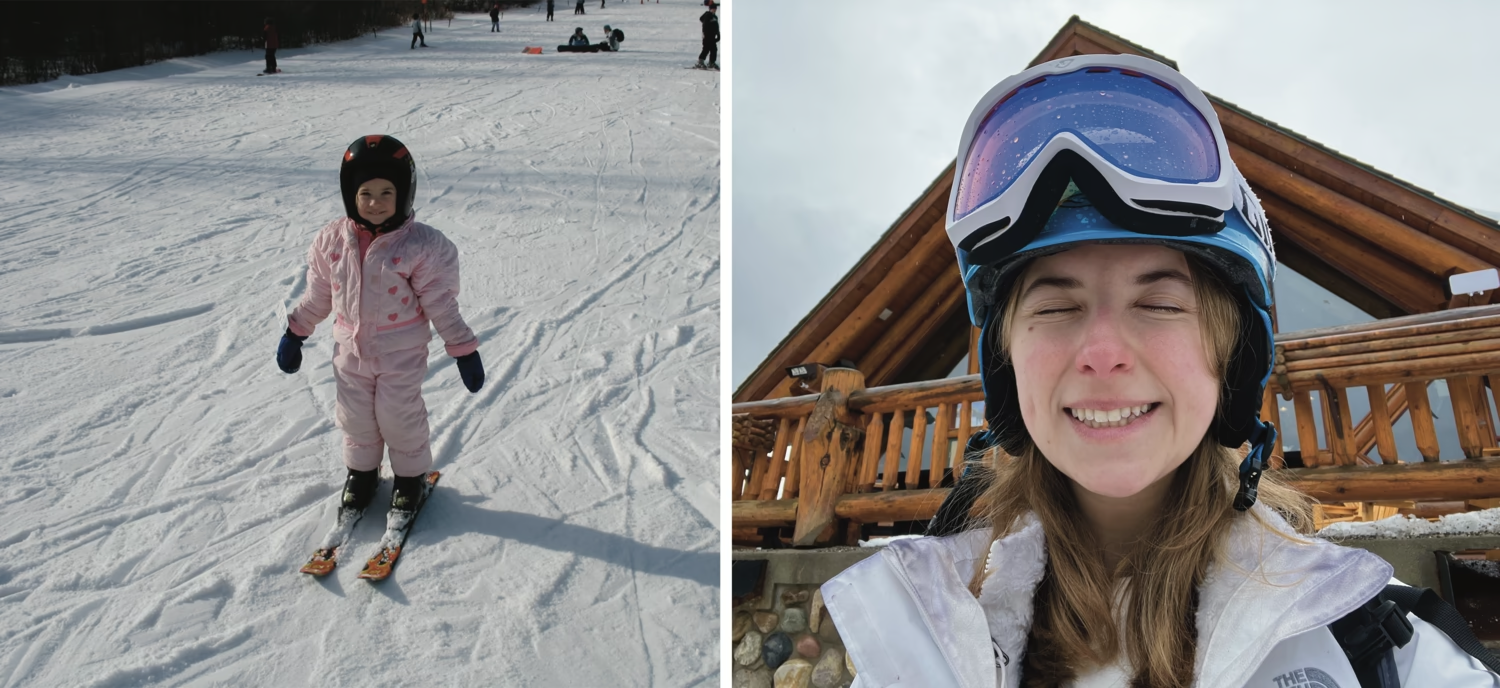
I’ve been skiing since I was three years old, and it’s my favorite thing in the world. The image to the left is me at four years old, on the bunny hill at Bristol Mountain in New York. The image to the right is from my first time skiing outside of the Northeastern United States at Lake Louise, Alberta, Canada.
What do you like to do in your free time?
I love to get outside and stay active. Most days I will go on a run or go to the gym. When I can, I love to go skiing, hiking, swimming, and play tennis. When I am feeling creative, I like to practice my photography, videography, and drawing skills. I have also been learning a few types of crafts recently such as sewing and embroidery. I think going outside and being creative is a great way to rejuvenate and relax.

I’ve been practicing film and digital photography since I was in high school.
Published Date: .
Hometown:
Fairport, NY
Undergraduate Degrees:
B.S. Environmental Science with a concentration in Environmental Geology from the University of Vermont, Burlington, VT.
B.A. Film and Television Studies from the University of Vermont, Burlington, VT