

What is your research focus?
I’m an astrobiologist and organic geochemist interested in the molecular origins of life on Earth and the search for life on other Solar System bodies. My main focus is investigating abiotic (non-biological) organics in extraterrestrial materials to understand how they formed and whether they may have contributed to the origin of life on Earth, and potentially on Mars. While there are many ways to search for life, analyzing organics is a great approach because all life on Earth uses specific sets of monomers (e.g., amino acids, nucleobases, carboxylic acids) to build larger biomolecules that provide structural support, encode information, and drive cellular processes, and extraterrestrial life is expected to do the same. On Earth, organics preserved in rocks as “molecular fossils” trace the history and evolution of biology over the past 4 billion years, so molecular fossils on other planets could potentially provide evidence of both extant and extinct life, particularly places like Mars that experienced early habitable surface conditions.
These molecular building blocks can form through a variety of abiotic (non-biological) mechanisms in the interstellar medium, the protoplanetary disk, and on planetary surfaces. Primitive carbonaceous meteorites and asteroids retain a molecular record of early Solar System chemistry, and these bodies contain many of the prebiotic organic building blocks required by biology. Asteroids and meteorites have rained down on the inner planets throughout the Solar System’s history, highlighting a potential link between exogenous delivery and the origin of life.
My research seeks to answer these questions through three major projects. First, I analyze organics in meteorites and returned asteroid samples in the laboratory to understand their molecular inventory and synthesis processes. Second, I utilize rover assets to search for organics on Mars, including both abiotic molecules formed in situ and potential biotic (biological) remnants, in an attempt to deconvolve their origins. Third, I work with a group at NASA Ames Research center to develop organics-focused life detection instrumentation that could be applied on future missions to Mars.
 spacecraft witness plates prepared in the Astrobiology Analytical Laboratory.](/files/ECSS/docs/assets/uploads/buckner-691-photo1.avif)
Extracts from the OSIRIS-REx spacecraft witness plates prepared in the Astrobiology Analytical Laboratory.
Did you always know that you wanted to study astrobiology?
I’ve always been fascinated by space and wondered about life beyond Earth, but I never realized this interest could lead to a career until after I finished my undergraduate degree in aeronautics and stumbled upon the University of North Dakota’s Space Studies department while searching for graduate programs. This interdisciplinary degree included courses in planetary sciences, astronomy, human factors, space law, and space management systems – basically space camp! I enrolled as an MS student and started out working with high altitude ballooning and human spaceflight technologies, but planetary sciences had me hooked. From there, I interned at NASA Ames Research Center, where I began working with life detection instrumentation development, analysis of organics in extraterrestrial materials, and investigating the molecular origins of life.

The Extractor for Chemical Analysis of Lipid Biomarkers in Regolith (ExCALiBR).
Tell us about the research projects you are currently working on.
As a member of the OSIRIS-REx soluble organics analysis team, I conduct laboratory analyses of organics in meteorites and samples returned from asteroid Bennu. I use wet chemistry preparation steps to extract organics from solid samples, then apply a variety of analytical methods for molecular and compound-specific isotopic characterization, including gas chromatography-mass spectrometry (GC-MS), two-dimensional gas chromatography-high resolution time of flight-mass spectrometry (GC×GC-HRToF-MS), and isotope ratio mass spectrometry (IRMS). This information helps catalog the inventory of prebiotic building blocks and investigate the astrochemical and geochemical processes by which they were synthesized.
I search for organics on Mars as a collaborator on the Scanning Habitable Environments with Raman and Luminescence for Organics and Chemicals (SHERLOC) instrument onboard the Perseverance rover. SHERLOC uses deep UV (DUV) Raman spectroscopy to identify and map minerals and associated organics across exposed or abraded rock surfaces. These in situ measurements are used to select astrobiologically-relevant samples for future return to Earth, where they could be studied in the laboratory with the same methods and instruments successfully applied to meteorites and asteroidal materials.
I also work with a group at NASA Ames Research Center to design and build next-generation life detection instruments with that will search for organics as potential biomarkers onboard future landed missions to Mars. My instrument of focus is a sample processing unit called the Extractor for Chemical Analysis of Chemical Biomarkers in Regolith (ExCALiBR), which replicates and automates techniques used in the laboratory to extract and concentrate organics from solid samples, then passes the purified extract off to a suite of coupled analytical units for downstream molecular characterization. My ExCALiBR tasks include setting science requirements, testing instrument performance against benchtop extraction methods with natural and synthetic samples, and leading contamination control and planetary protection protocols.
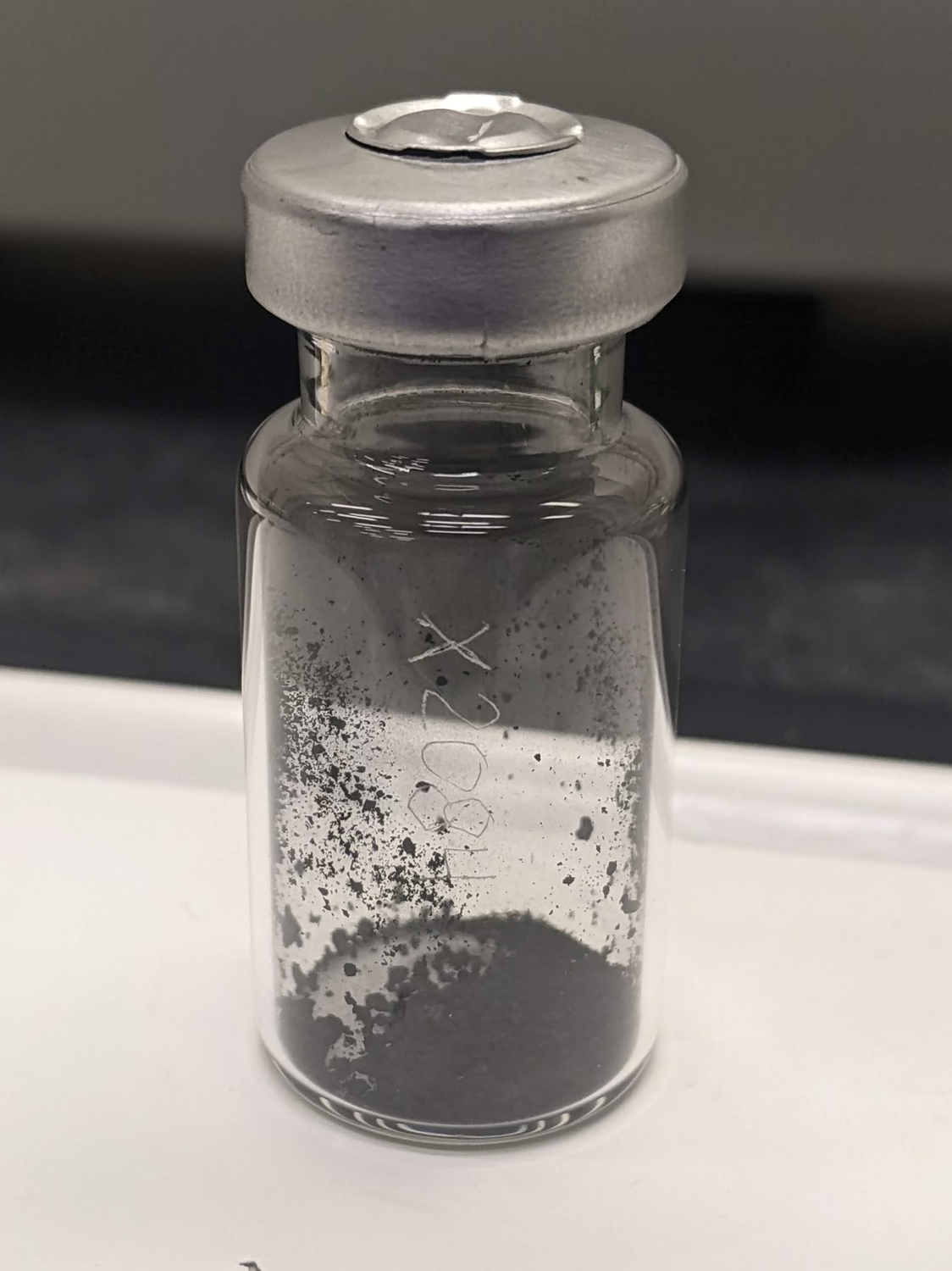
Material returned from asteroid Bennu.
What science questions do you investigate?
The questions that compel me the most include:
- Where and how are abiotic organics synthesized throughout the Solar System?
- Did abiotic organics delivered by meteorites and asteroids contribute to the origin of life on Earth?
- Did life ever emerge on Mars?
- How can we ascertain whether organics on Mars are the products of abiotic meteoritic infall, abiotic geochemical processes that operate on Mars, or remnants of biology?
- What instruments and missions can we design now to best continue the search for life on Mars into the future?
- Is there life on other habitable bodies in the Solar System?

The Perseverance rover with the Cheyava Falls target.
What is one thing you wish everyone knew about your particular field of science?
As we continue to look for life on other planets, identifying molecular biosignatures requires an understanding of abiotic processes and components. This information is essential for ascertaining whether the molecular building blocks required for life were likely available in potentially habitable environments, differentiating whether organics detected were formed through biological or non-biological processes, and preventing false positives and/or negatives.
What early career advice do you have for those looking to do what you do?
Find your passion! What question compels you, and how can you answer that question? If you’re driven towards your research goal, even mundane tasks can feel intriguing. Flexibility is also super important, because you never know where your results will lead, and the ability to pivot your focus will open up a lot of opportunities. Finally, don’t be afraid to fail – research is challenging, but persistence is key.

Artemis I launch.
What is a fun fact about you?
I’ve moved around a lot and have lived in nine states: Arizona, Maryland, Georgia, Ohio, Missouri, North Dakota, California, Florida, and Washington D.C. My favorite part of moving is exploring niche places off the beaten path, like ghost towns in the desert, the world’s biggest marble collection, geological wonders in remote national parks, and unique graffiti art that varies so much in each city. I love traveling in general, and one of my favorite experiences was seeing the sun rise over the Atlantic in Florida before flying to California, where I saw the sun set over the Pacific on the same day. Another striking day was a road trip from a conference in Houston with other students in my M.S. program, where the morning began with 90 degree heat in Texas and the night ended with a blizzard in North Dakota.
Published Date: .
Hometown:
I’ve moved around too much to have a real hometown, but I identify most with St. Louis, MO.
Undergraduate Degree:
B.S. in Aeronautics (concentration in Aviation Management, second major in English), Saint Louis University, St. Louis, MO
Post-graduate Degrees:
M.S. in Space Studies (concentration in Planetary Sciences, minor in Biology), University of North Dakota, Grand Forks, NDPh.D. in Geology, University of Florida, Gainesville, FL