
What inspired you to pursue a career in meteorology?
My interest in science began with a fascination for predicting the future. As a teenager, I spent countless hours watching National Geographic documentaries about earthquakes. Seeing the devastation they caused made me wonder whether we could ever predict such events, and that curiosity led me to pursue geology at a community college near Seattle. My first course, Introduction to Geology, drew me in immediately—but by the time I reached the course on rocks, I realized that studying their composition wasn’t where my passion lay.
Around that same time, I discovered storm chasing documentaries on the Discovery channel, and they sparked a whole new excitement about atmospheric science. The turning point came in 2005 during a family trip to Orlando, Florida—right in the middle of hurricane season. When Hurricane Frances, a Category 2 storm, swept through the area and shut down the theme parks, I found myself mesmerized by the power of nature. While my family ate dinner under curfew conditions, I sat outside watching palm trees bend dramatically in the hurricane force winds near the storm’s eyewall. That moment crystallized my desire to study meteorology. It ultimately led me to the University of Washington, where I pursued a degree in Atmospheric Science and began the journey that brought me to where I am today.
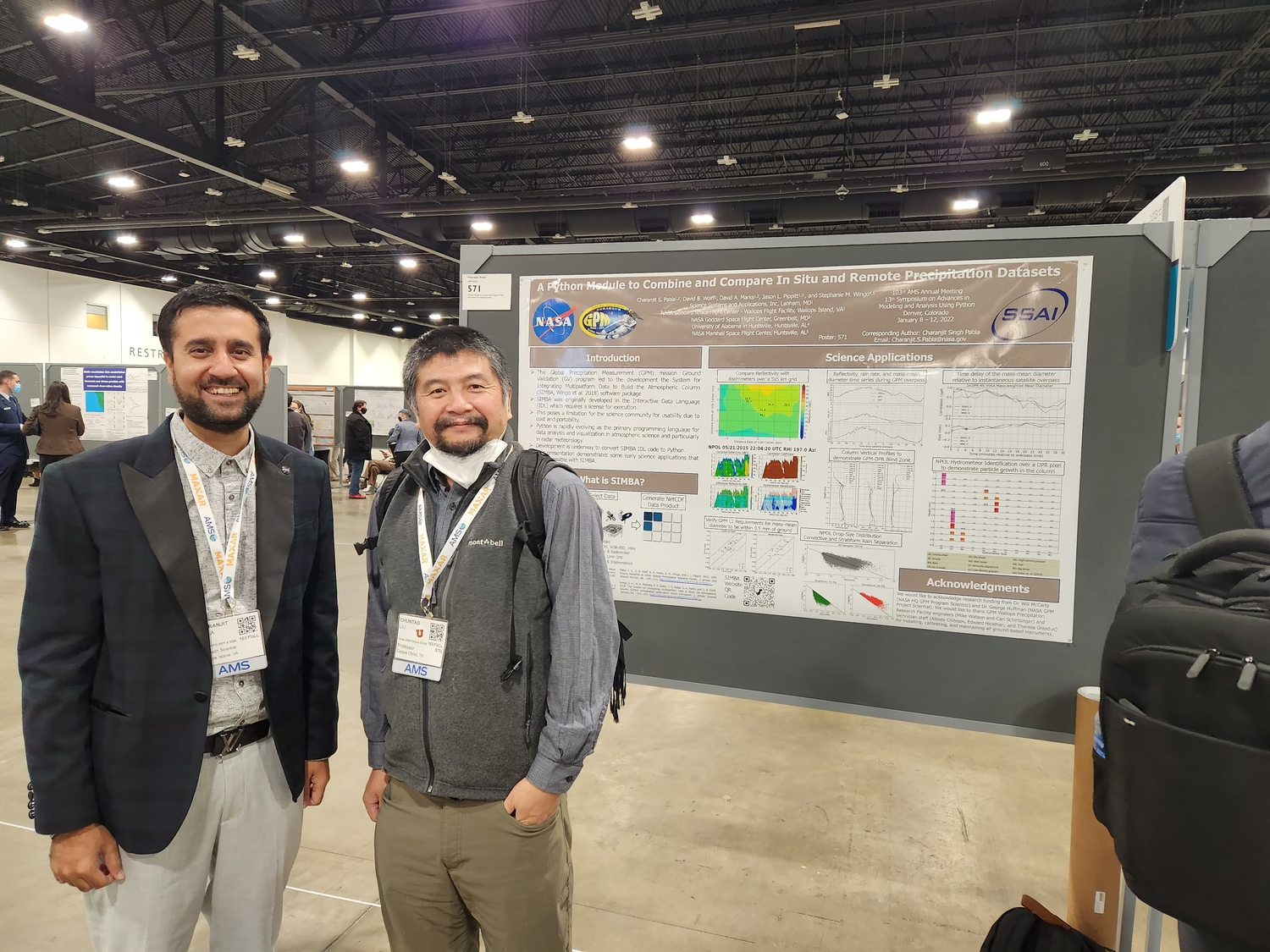
Presenting at the American Meteorological Society conference in Denver, CO in January 2023.
How did you end up working at NASA Goddard?
My path to NASA Goddard can be traced back to my graduate school years. I had always been told to connect with people at meetings, conferences, and school, and that advice proved to be very invaluable. During my thesis work, I was mentored by a researcher involved in my project on using video disdrometers to study how weather radar empirical algorithms change as a function of the disdrometer temporal sampling period. A video disdrometer is a specialized meteorological instrument used to measure the size, shape, and fall velocity of precipitation particles, such as raindrops, snowflakes, and hail. Because we stayed in touch as I adventured out from graduate school on to my first job as a weather forecaster, I reached out to him when I realized I wanted to pursue a research career. At the time, he was working at NASA Wallops Flight Facility, developing the Precipitation Research Facility under the Global Precipitation Measurement mission program. Just a few weeks later, he let me know about an open position at Wallops. I seized the opportunity, and now, more than nine years later, I’m proud to say that decision led me to a fulfilling career at NASA.

Photo taken at NASA Kennedy Space Center Visitor Complex in February 2026.
What aspects of your work are you most passionate about?
I’m driven by the excitement of learning something new every single day. Weather and precipitation are constantly changing—hotter in some areas, cooler in others, wetter here, drier there—and I’m fascinated by the science behind those shifts. Why does it rain at my house but not at my friend’s? How much snow will we get this winter? I love digging into questions like these.
Of course, the atmosphere is complex. Understanding it requires physics, mathematics, and careful observations. One part of my job that I truly enjoy is finding ways to communicate these complex ideas to students, educators, and the general public. Explaining how weather works in a way that’s accessible and engaging is both a challenge and a joy—and it’s a big part of what keeps me passionate about my work.

Presentation to a group of New York City high school students on the Global Precipitation Measurement (GPM) Mission Ground Validation program in March 2025.
If you were to expand your current research focus, what new topic(s) would you explore?
I’m excited by the future of satellite radar technology and the possibilities it holds. Today, the Global Precipitation Measurement Core (GPM Core) Observatory carries the world’s first dual‑frequency precipitation radar, and upcoming systems will even be able to measure particle velocities using Doppler techniques. Measuring particle velocity from a satellite radar is exciting because it provides a global, 3D view of internal storm dynamics, filling critical data gaps over vast oceans and remote regions where ground radars cannot reach. This unprecedented data on vertical winds and precipitation speeds is essential for understanding cloud behavior and significantly improving our understanding of precipitation microphysics. But what truly inspires me is the idea of placing a dual‑polarimetric radar in space. By sending out electromagnetic pulses in two orientations, we could dramatically improve our ability to observe and understand precipitation particles from orbit—offering a richer, more detailed view of weather systems across the entire globe, especially over the vast oceans.
What do you enjoy the most about your job?
My favorite part of my job is forecasting the weather for our field campaigns, operating the radar to collect data, and processing data for research. It all begins with a weather forecast in conjunction with the GPM Core satellite overpass over our ground instruments on the Eastern Shore of Maryland and Virginia and firing up NASA’s Dual-Polarimetric Radar (NPOL). Next, I process the data collected from various ground instruments and compare with the satellite retrievals to understand where algorithms are performing optimal and identify gaps to improve those algorithms. This requires writing computer programs to process vast amounts of data in short period of time. Then, I write about the outcomes and showing visualizations to communicate to experts and general audience.
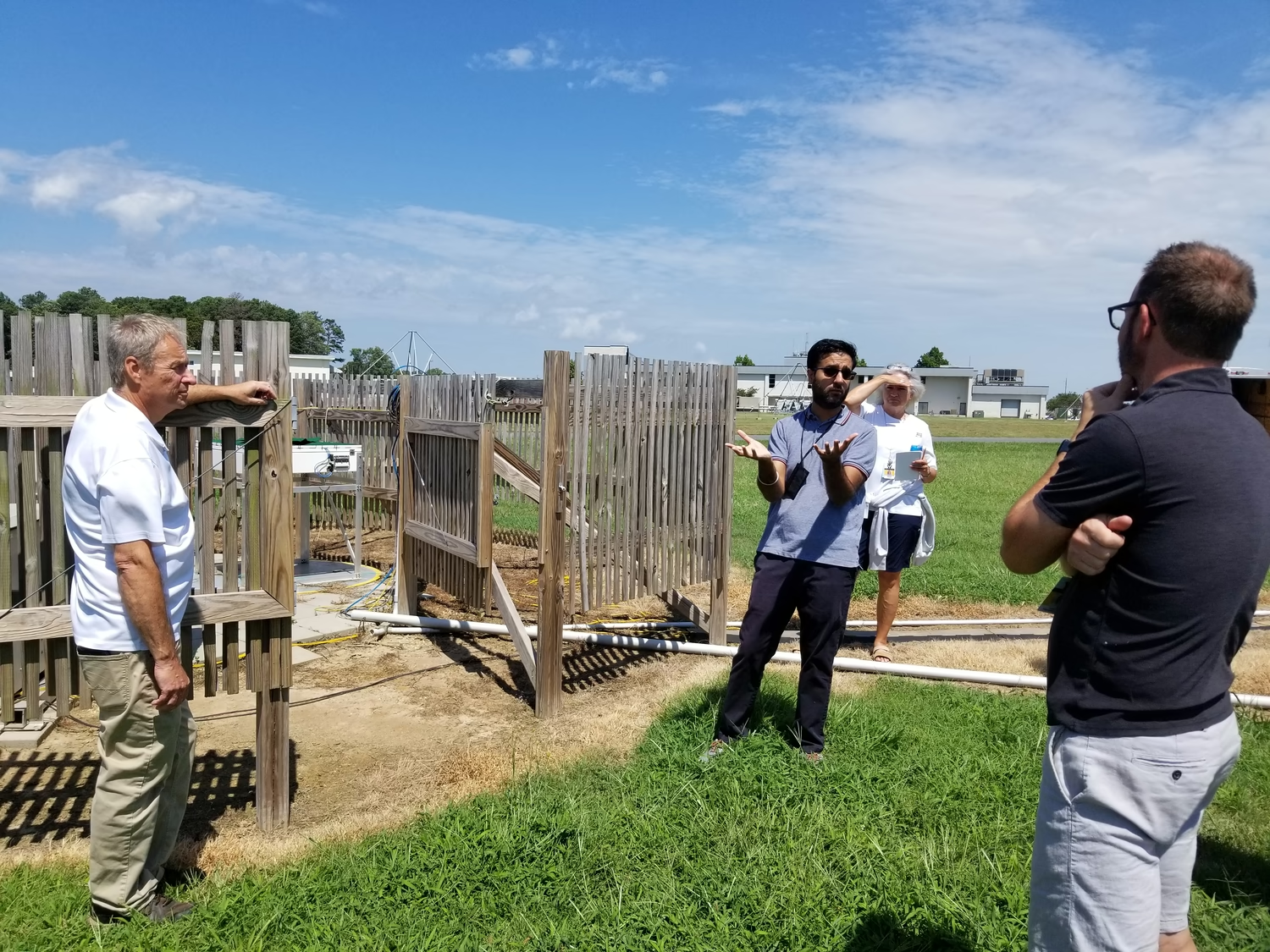
Educating school teachers on disdrometer measurements taken inside a two-third scaled double wind fence during Wicomico County Educator Workshop at NASA Wallops Flight Facility in August 2023.
What is one of your favorite moments in your career so far?
One of the standout moments in my career took place during graduate school in Huntsville, Alabama, when I joined NASA’s Global Precipitation Measurement Mission Ground Validation field campaign, the Integrated Precipitation & Hydrology Experiment, in Central North Carolina in 2014. It was the first major field effort following the launch of the GPM Core Observatory earlier that year, and being part of it as a student felt incredibly meaningful. I worked on the ground validation team, maintaining rain gauges and disdrometers spread across the region. Each morning, my team set out to inspect, clean, and repair instruments—often driving for hours through rural North Carolina to keep everything running smoothly. It was thrilling to be immersed in hands‑on field science, knowing that the data we gathered would help validate satellite measurements and advance our understanding of global precipitation.

(Left) Enjoying time with my parents visiting The World War II Memorial. (Right) Eiffel tower in the background on a family vacation trip to Paris, France in June 2024.
What do you like to do in your free time?
In my free time, I love spending time outdoors with my wife and son. We enjoy biking around the neighborhood, playing sports together, and talking about the nature and weather we see along the way. We’re also big fans of great food and discovering new places. My wife and I make it a tradition to travel domestically and internationally at least twice a year, exploring different cultures and experiencing the beauty of nature in all corners of the world. These moments together keep us grounded, inspired, and always curious.
Published Date: .
Hometown:
Phagwara, India
Undergraduate Degree:
B.S. Atmospheric Science, University of Washington, Seattle, Washington
Post-graduate Degree:
M.S. Atmospheric Science, University of Alabama Huntsville, Huntsville, Alabama