Stellar Astrophysicist
Dr. Aishwarya Iyer
(she/her)
667 Exoplanets and Stellar Astrophysics Laboratory
What inspired you to pursue a career in Astrophysics?
My interest in Astrophysics began when my dad first read me Stephen Hawking’s ‘A Brief History of Time’ around the age of 7. While I didn’t understand anything in the book, the beautiful pictures always enchanted me to keep thinking about outer space. I remember being enchanted by an illustration showing the extraordinary range of scales in nature—from tiny quarks to the vastness of the universe. It sparked a fascination that grew with me through college, thinking about how the same laws of physics can connect the smallest building blocks of matter to the largest structures in the cosmos.
My path to pursuing Astrophysics, however, was not a direct one. I was deeply involved in environmental activism in my teenage years and began community college studying biology and microbiology, and then continued college majoring in environmental chemistry. As I studied chemistry, I found myself especially drawn to physical and inorganic chemistry, which led me to ask increasingly fundamental questions about how matter behaves. That curiosity brought me to quantum mechanics and eventually inspired me to major in physics. I explored several areas through electives including plasma physics, but it was during an astrophysics course where everything clicked. Learning about magnetic phenomena on the sun—particularly sunspots and solar prominences—completely captivated me. That class showed me how the physics I loved could be used to understand stars and the wider universe, setting me on the path to a career in astrophysics.
What science questions do you investigate?
My research combines theoretical models, telescope observations, and computational tools to ask how accurately we can determine the properties of low-mass stars from their spectra. A spectrum is created by separating a star’s light into its component wavelengths, producing patterns that act somewhat like a barcode. Those patterns contain information about the star’s temperature, chemical composition, gravity, and magnetic activity.
I focus primarily on M dwarfs, the smallest, coolest, and most abundant stars in the galaxy. Their spectra are complicated because molecules, clouds, magnetic fields, and features such as cool starspots can all alter the light in similar ways. I investigate how to distinguish among these effects and how to recognize when our models are missing important physics. This work is also essential for studying exoplanets. When a planet passes in front of its star, we look for small changes in the starlight that can reveal the planet’s atmosphere. However, starspots and other uneven features on the stellar surface can create signals that resemble those of the planet. By modeling the star and planet together, I aim to separate these signals and improve our interpretation of exoplanet atmospheres.
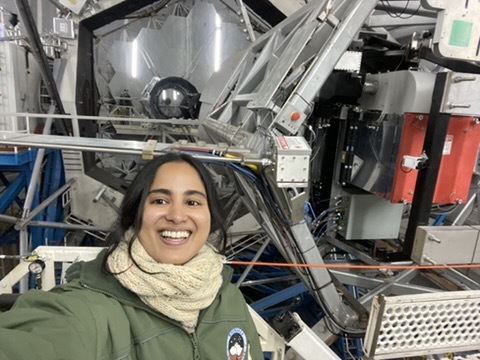
Picture taken inside the W. M. Keck Observatory Keck II. In the background is the Keck II mirror, about 32 ft primary mirror consisting of 36 hexagonal mirror segments (Keck was the first observatory to demonstrate that segmented mirrors are a practical design inspiring later giant telescopes including JWST), each about 6 ft across precisely aligned to function as one single mirror.
Tell us about one project (of yours) that has been particularly impactful in your field.
One of my most significant projects has been developing SPHINX, a library of theoretical atmospheres and predicted spectra for M dwarfs. For each model, I begin with a possible set of stellar properties, such as temperature, gravity, and chemical composition. The model then uses fundamental physics to calculate the structure of the star’s atmosphere, including how energy travels through it, which molecules form, how those molecules absorb light, and whether clouds may develop. From that atmosphere, SPHINX predicts the spectrum that a telescope should observe. I compare this library of predicted spectra with real observations: the closest matches allow us to estimate a star’s properties, while persistent differences reveal where the models may be incomplete.
During my NASA Postdoctoral Fellowship at Goddard, I have expanded this theoretical project into a program that combines models, telescope observations, and mission science. I have led high-resolution observing programs using NASA’s Infrared Telescope Facility and the W. M. Keck Observatory. By examining individual atomic and molecular features in a star’s spectrum, we can distinguish changes caused directly by magnetic fields from those caused by cooler starspots or other temperature variations. I also apply this research as a member of the science team for NASA’s Pandora SmallSat mission, which is currently conducting science observations. Pandora observes stars and their planets in visible and infrared light, helping us determine which signals originate from the star and which truly come from an orbiting planet’s atmosphere.
Accurately characterizing M dwarfs has implications across astronomy. These stars make up most of the Milky Way’s stellar population, host many nearby rocky planets, and preserve information about the galaxy’s chemical history. When an M dwarf shares a system with a brown dwarf or a more massive star, their common age and origin also allow us to test theories of how different types of stars and substellar objects form and evolve.
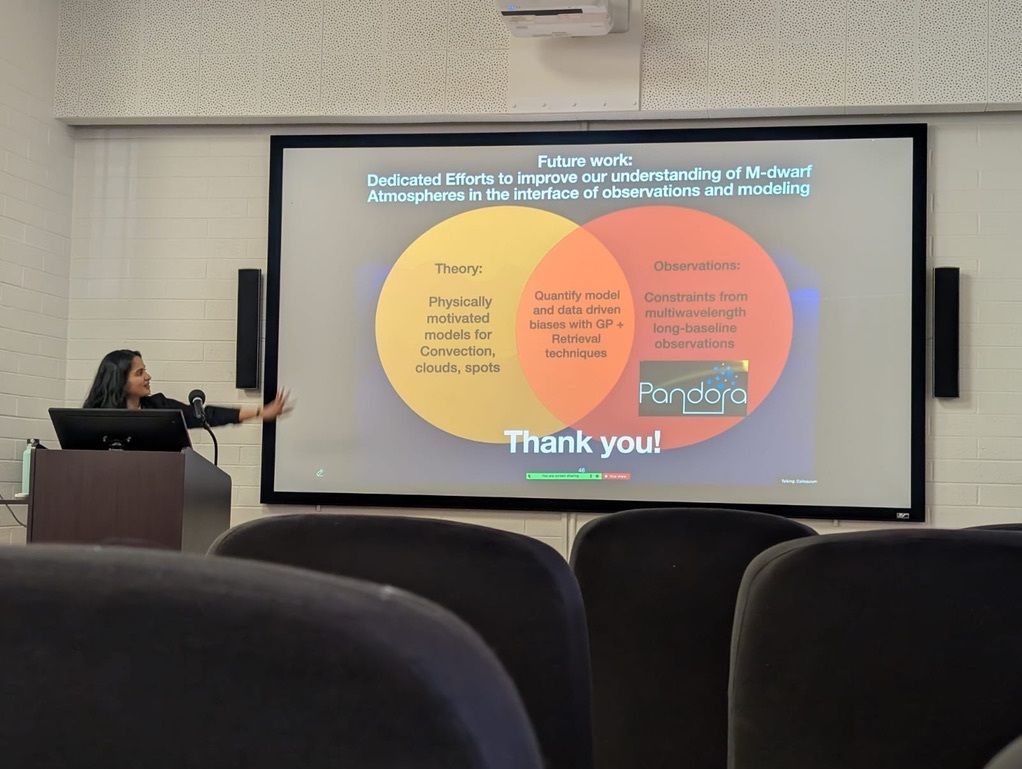
Picture of a talk given at Lowell Observatory in Flagstaff, AZ, showing the core philosophy of my research, lying in the interface of theoretical, observational, and statistical techniques. Also, a special shout out to my involvement with the Pandora SmallSat Mission.
What scientific challenge intrigues you the most?
The scientific challenge that intrigues me most is determining what a disagreement between an observed spectrum and a theoretical model is actually telling us. Does the discrepancy mean that we inferred the wrong temperature, gravity, or chemical composition within an otherwise adequate model, or does it indicate that the model itself is missing an important physical process? This is especially difficult for M dwarfs because molecular opacities, clouds, convection, magnetic fields, starspots, and thermal perturbations can produce similar spectral signatures. Even a statistically precise result may therefore be physically inaccurate if the model does not adequately represent the star. The challenge is not simply finding the model that produces the best fit, but determining whether the inferred properties are physically trustworthy and identifying which missing atmospheric processes must be added. This becomes particularly important in exoplanet studies, where relatively small errors in the stellar model can propagate into—or even be mistaken for—features attributed to a planet’s atmosphere.
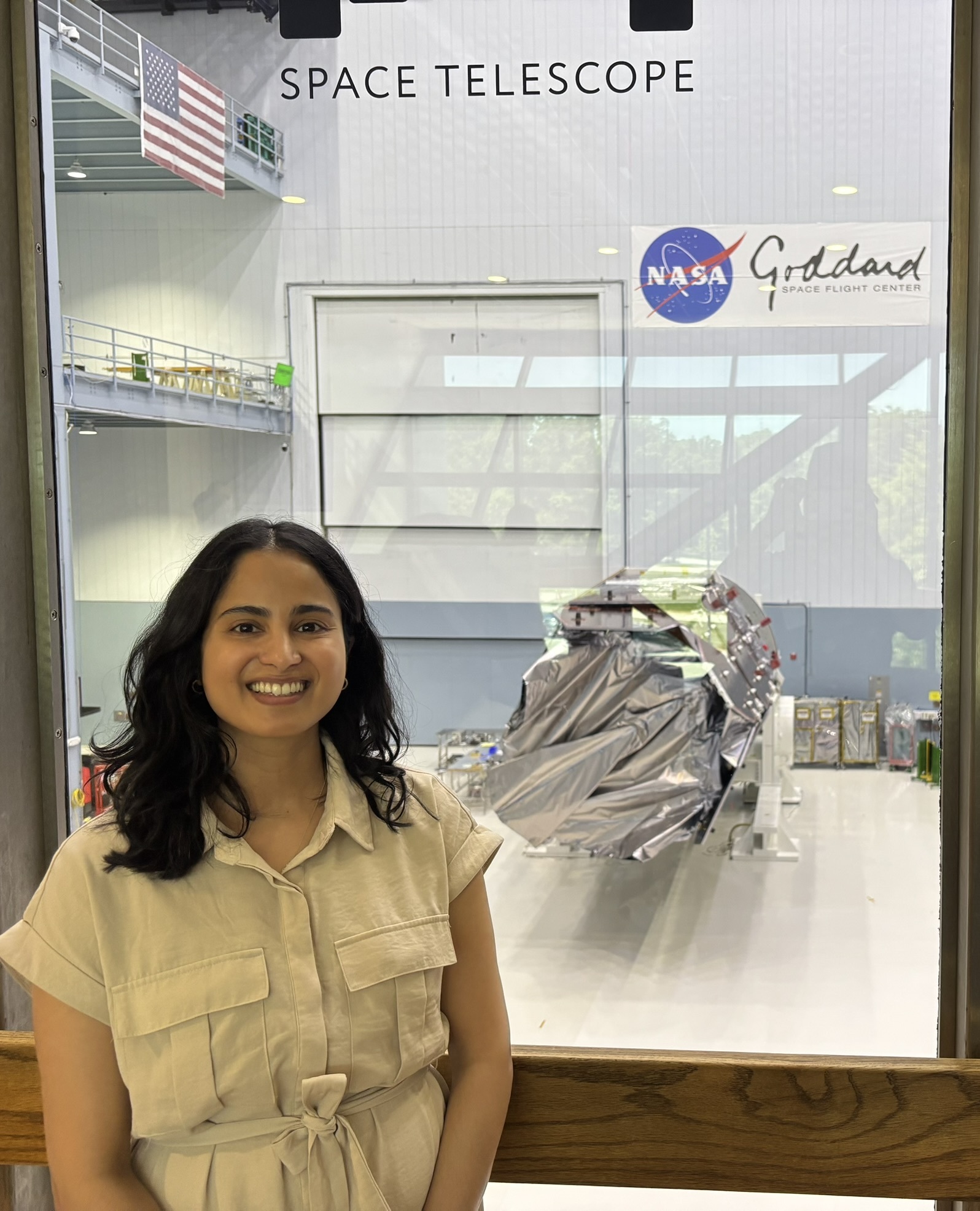
Picture taken with the Nancy Grace Roman Space Telescope in the GSFC clean room. Roman’s Galactic Bulge microlensing survey will discover planets around many low-mass stars, including M dwarfs, so accurate stellar properties are essential for determining the planets’ masses and interpreting their demographics. Additionally, because M dwarfs dominate the Galactic stellar population, improving their models will also strengthen Roman’s broader studies of the Milky Way’s structure and evolution.
If you were to expand your current research focus, what new topic(s) would you explore?
I would like to expand my research by developing statistical and machine-learning methods that use model-data discrepancies as quantitative diagnostics of missing physics. One framework I am currently developing, tests whether the residual between an observed and modeled spectrum resembles the spectral changes produced by varying parameters already included in the model. If it does, the discrepancy may be recoverable within the existing model family. If it does not, it points toward missing physics or an additional atmospheric dimension. This would move atmospheric retrievals beyond simply estimating the best-fitting parameters and turn them into tools for improving the underlying models themselves—for example, by identifying where treatments of molecular opacity, convection, clouds, or magnetism need to be revised.
I would also extend this work from present-day stellar atmospheres to the coupled evolution of stars and their planets. I am particularly interested in developing a “star-aware” cosmic shoreline—the empirical boundary separating planets that retain substantial atmospheres from those that are effectively airless. By combining improved stellar parameters and magnetic-activity histories with atmospheric-escape calculations and planetary observations, I want to investigate whether some rocky planets classified as airless have truly lost their atmospheres or whether incomplete stellar models have affected that interpretation. Together, these directions would connect detailed stellar physics to the broader question of which planetary systems are most likely to sustain long-lived, potentially habitable environments.
What advice would you give your younger self?
I would tell my younger self not to mistake a nonlinear path for a lack of direction. My route from biology to environmental chemistry, physics, and finally astrophysics sometimes felt as though I were repeatedly starting over. In reality, none of those earlier experiences was wasted. Biology taught me experimental discipline, chemistry taught me to think about molecules and their interactions, and physics gave me the mathematical framework to connect those processes to stars and planets. My research now draws upon all of those perspectives.
I would also tell myself to follow the questions that genuinely spark curiosity, ask for help, and pursue opportunities before feeling completely prepared. There is no single correct route into science, and it is unhelpful to compare your path with someone else’s more linear trajectory. A scientific identity can be built gradually from every skill, question, and apparent detour along the way.

Picture taken inside the NASA’s Infrared Telescope Facility (IRTF). Inside the dome, the dominant feature is the 3-meter infrared telescope supported by a massive steel equatorial mount, with instruments attached beneath.
Where do you see yourself in the near future?
My immediate next step will be to continue this research as a Giacconi Fellow at the Space Telescope Science Institute. Building on my work at NASA Goddard, I plan to develop the next generation of low-mass stellar atmosphere models, test them against high-precision observations from ground- and space-based telescopes, and create statistical tools that identify limitations in the underlying model physics. I also hope to remain involved with NASA’s Pandora SmallSat mission and contribute to future observatories designed to characterize potentially habitable worlds.
Over the longer term, I hope to move into an independent faculty or research-scientist role and build a research program connecting stellar astrophysics, exoplanet characterization, computational methods, and space-mission science. I want to lead a collaborative group that works across theory, observations, and data science while making its model grids and analysis tools openly available to the broader community. Mentoring students—particularly those who enter astrophysics through community college, interdisciplinary programs, or other nonlinear paths—would be an equally important part of the career I hope to build.
Published Date: .
Hometown:
Mumbai, India and Los Angeles, CA
Undergraduate Degree:
B.S. Physics, University of California San Diego, La Jolla, CA
Post-graduate Degrees:
M.S. Physics, California State University Northridge, Northridge, CAPh.D. Astrophysics, Arizona State University, Tempe, AZ