
What is your research focus?
The magnetosphere is the region of space surrounding Earth that is governed by Earth's magnetic field. It forms through the interaction between the solar wind—a stream of charged particles from the Sun—and Earth's magnetic field. Within this region, high-energy charged particles become trapped. Particles with energies ranging from a few kilo-electron volts (keV) to a few hundred keV form a donut-shaped current system in the inner magnetosphere (about 2–8 Earth radii from Earth's center), known as the ring current. Even more energetic particles, ranging from a few hundred keV to several mega-electron volts (MeV), form the radiation belts that surround Earth. These energetic particles adversely affect artificial satellites by penetrating their onboard electronics, pose health risks to astronauts, and alter polar atmospheric chemistry when they penetrate deep into the atmosphere. My research focuses mainly on the dynamics of these energetic particles in Earth's inner magnetosphere, including the ring current and radiation belts, during geomagnetic disturbances. A central question in my work is to understand what physical mechanisms control the transport, acceleration, and loss of these particles.
To address these questions, I combine satellite observations, ground magnetometer data, and physics-based modeling. My work involves multi-instrument data analysis and comparisons with models. I am interested in integrating data-driven approaches with physical models to improve predictive capability. As part of my role at the Community Coordinated Modeling Center (CCMC) at NASA GSFC, I also develop post-processing and visualization tools for inner magnetosphere models and contribute to model onboarding, ensuring these models are accessible and useful to the broader scientific community. Ultimately, my goal is to advance our understanding of magnetospheric dynamics and contribute to more reliable space weather forecasting.

In the background Nancy Grace Roman space telescope at NASA GSFC.
Did you always know that you wanted to be a space physicist?
Not exactly. Ever since I was a child, I have been captivated by the night sky and fascinated by the stars. My elder brother would share intriguing facts about stars and galaxies, and during those moments, I dreamed of becoming an astronaut. However, I did not have the opportunity to study space physics until my master's degree, when I was introduced to plasma physics. This experience sparked my interest in space plasma and motivated me to pursue research opportunities in this field. I later came across an advertisement for Ph.D. from the Indian Institute of Geomagnetism, which marked the true beginning of my journey in space physics. There, I was introduced to various aspects of magnetosphere-ionosphere coupling and space weather. During my postdoctoral research at Nagoya University, Japan, I learned a lot about magnetospheric dynamics. These experiences and the knowledge I gained ultimately led to the valuable opportunity to work at NASA GSFC.
What began as childhood curiosity has since evolved into a research career dedicated to understanding space weather and its impacts on our technological society. Although my childhood dream of becoming an astronaut did not materialize, I take pride in knowing that my research on space weather directly supports astronauts and their missions. This journey has taught me that the path to one’s passion is rarely straightforward, but persistence and curiosity can ultimately lead to meaningful and fulfilling outcomes.

Attending AGU Meeting 2024 at Washington D.C.
What skills are most useful to you in your work, and where did you develop those skills?
The most useful skills in my work are a combination of domain expertise and technical proficiency. A deep understanding of ionospheric and magnetospheric physics is essential for interpreting observations and developing meaningful research questions. Equally important are programming skills, data analysis, and physics-based modeling, which I use daily to analyze satellite observations and compare them with simulations.
I developed the foundation for these skills during my Ph.D. at the Indian Institute of Geomagnetism, under the mentorship of Prof. B. Veenadhari, where I worked extensively with satellite and ground-based data to study various aspects of magnetosphere-ionosphere coupling. I further strengthened these skills during my postdoctoral tenure with Prof. D. Chakrabarty at the Physical Research Laboratory, India. Later, at Nagoya University, Japan, I refined my analytical and modeling skills in inner magnetospheric dynamics under the guidance of Prof. Y. Miyoshi. Working in an international research environment strengthened my ability to collaborate effectively with researchers across institutions and countries.
At CCMC at NASA GSFC, I continue to expand my skill set by working with experienced colleagues. I am strengthening my programming and analytical skills and broadening my understanding of space weather modeling infrastructure to better serve the space weather community. Each stage of my career has built upon the previous one, and I am grateful for the mentors and collaborators who have helped me grow as a researcher. Behind all of this, my family has been my constant source of strength. I am deeply grateful to my wife for her unwavering support, patience and motivation, which have made this journey possible.

My wife and I in traditional Indian dress (left) and traditional Japanese dress (right).
What is one of your favorite moments in your career so far?
One of my favorite moments in my career was receiving the JSPS postdoctoral fellowship to work with Prof. Y. Miyoshi at Nagoya University, Japan. Under his mentorship, I gained valuable insights into inner magnetospheric dynamics and conducted several collaborative studies on ring current processes. This opportunity not only enriched my knowledge but also paved the way for my current position at NASA GSFC. That is why it remains one of the most significant moments in my career so far.
What do you enjoy the most about your job?
What I enjoy most about my job is the combination of exploration, collaboration, and real-world impact. Every dataset presents a new puzzle about Earth's magnetosphere, and solving these puzzles is incredibly rewarding. I also value the collaborative nature of science—my journey from India to Japan to NASA has connected me with wonderful mentors and colleagues who continue to inspire me. Most importantly, knowing that my research on space weather can help protect satellites and astronauts, and that the tools I develop at CCMC will help advance space weather research and forecasting, gives my work a sense of purpose that keeps me motivated every day.

Taken on a hike to Matheran during my Ph.D. — proof that I was once slim and fit!
What do you like to do in your free time?
In my free time, I enjoy a variety of activities that help me unwind and recharge. I love going for long walks and hiking—during my Ph.D., I did countless hikes in the beautiful mountains of the Western Ghats (hill ranges in the Indian subcontinent). I also enjoy watching sports, movies, listening to old, soulful Bollywood and Punjabi songs. Cooking is another skill I have developed over the years, and I truly enjoy it. I like reading books and current affairs, too. However, since my daughter was born, playing with her has become my new favorite way to spend my free time. These moments refresh my mind and give me the energy to return to my research with renewed focus.
What are your future research interests and goals?
My future research interests involve broadening my work from Earth's space weather to planetary space weather. I am particularly interested in understanding the space environment around the Moon, Mars, and other planets. As humanity prepares for extended lunar missions and eventual crewed missions to Mars, understanding the radiation environment and space weather conditions at these destinations becomes crucial. I aim to apply my expertise to these emerging challenges and contribute to developing a planetary space weather prediction framework that supports safe and sustainable human exploration of the solar system.
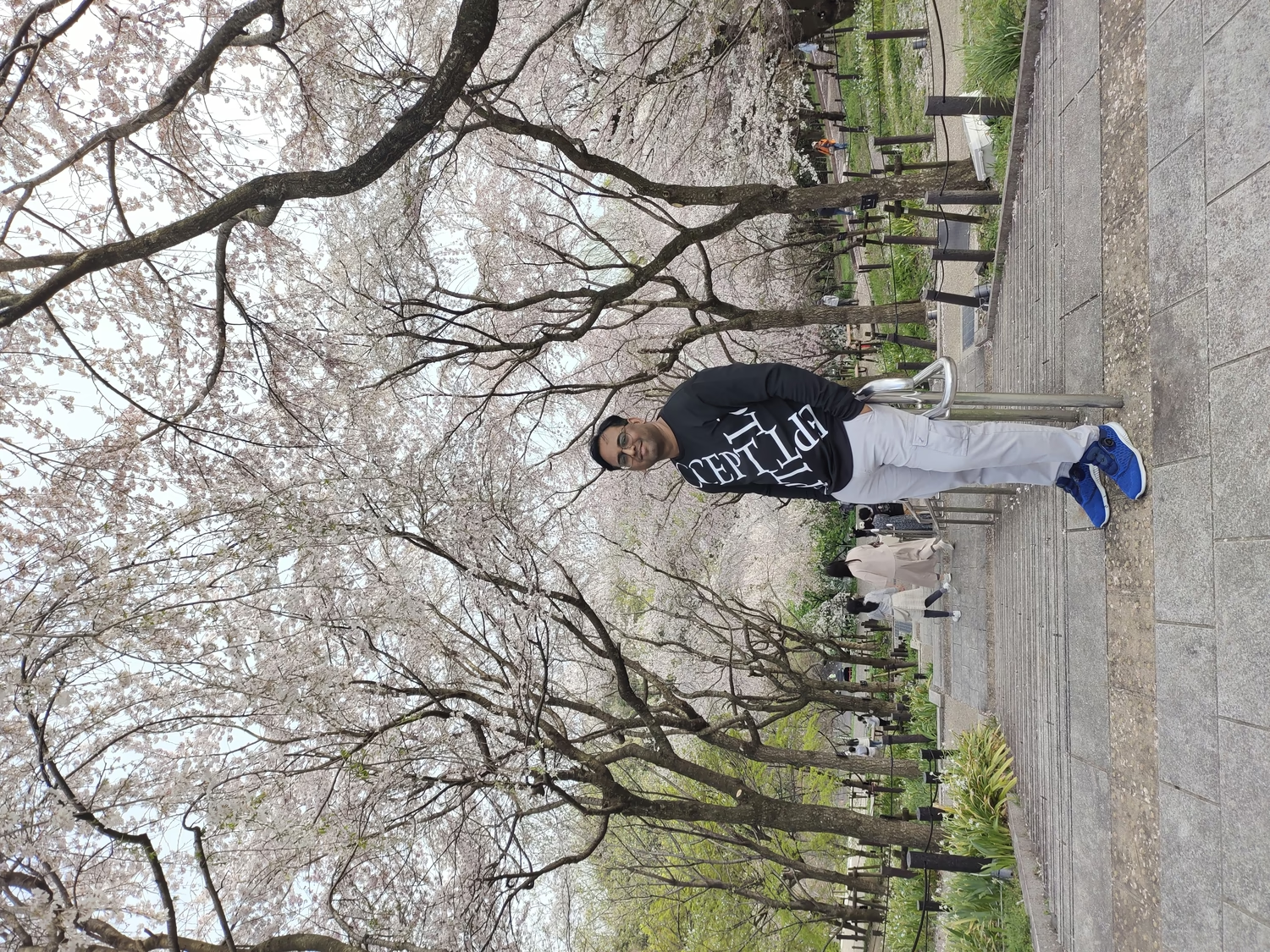
Enjoying cherry blossom at Nagoya, Japan.
Published Date: .
Hometown:
Jalandhar, Punjab, India
Undergraduate Degree:
Bachelor of Science, Doaba College/Guru Nanak Dev University, India
Post-graduate Degrees:
Master of Science in Physics, Dr. B. R. Ambedkar National Institute of Technology, Jalandhar, IndiaPh.D. in Physics, Indian Institute of Geomagnetism (affiliated to University of Mumbai), India