

Did you always know that you wanted to be an astrobiologist?
I always knew I was interested in space, but when I began university, I didn't fully appreciate the breadth of space careers that were possible. I had never heard of astrobiology. I thought the only pathway to studying space was through astrophysics, so that's the program I enrolled in. It proved to be a bit too abstract for me; I'm a very tactile learner who needs to engage with the physical world.
After meeting with an academic advisor, I discovered Earth science and comparative planetology, where I could study our own planet and use it as an analog for other worlds in our solar system. That approach resonated with me, and I transferred into a geology program. As I progressed through my degree, I met my undergraduate supervisor, an organic geochemist and astrobiologist who introduced me to the detective work of reading life's chemical signatures in ancient rocks. I never imagined I would enjoy organic chemistry. Truly, I didn't. But I became captivated by the concept of chemical fossils: the idea that life leaves behind enduring yet invisible molecular traces in the rock record.
For most of Earth's history, long before organisms evolved that could leave behind physical fossils like bones, footprints, or shells, microorganisms were the only inhabitants of our planet. These ancient microbes left molecular signatures, such as lipids from decaying cell membranes, degraded pigments, or distinctive isotopic patterns. These chemical imprints reveal not just that life existed, but how it functioned, what it metabolized, and how it adapted to environmental pressures. The realization that we could decode these invisible narratives preserved in Earth's oldest rocks, and potentially recognize similar signatures on Mars or other worlds, fascinated me completely.
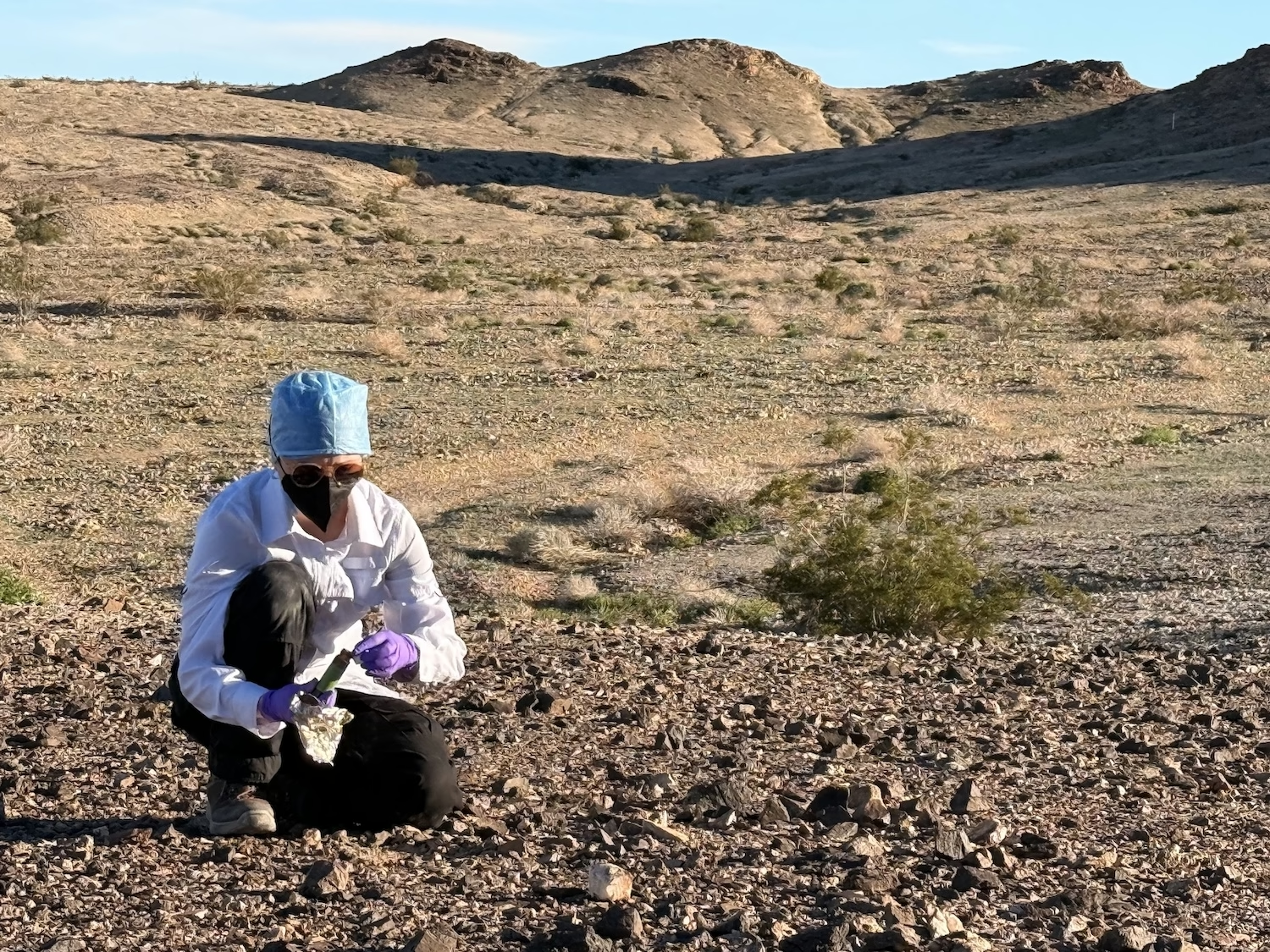
Fieldwork takes me to some of the most extreme and remote corners of our planet, and that's one of my favorite parts of the job. Here, I'm collecting samples in the Mojave Desert, where the extremely arid and salty soils mirror conditions we may encounter on Mars.
Tell us about the research projects you are currently working on.
I'm currently working on a field sampling project in the Mojave Desert to understand how life survives in extremely arid environments with salty soils, which may resemble some of the conditions that developed on Mars as it transitioned from a wetter to drier planet. These extreme conditions don't just challenge living organisms; they also alter the chemical traces those organisms leave behind. My research investigates how aridity and salinity affect both the production of chemical fossils and their long-term preservation. In particular, I'm studying the interactions between organic molecules and mineral salts, which can have complex and sometimes contradictory effects on organic stability. By understanding these processes in Earth's extreme environments, we can better interpret potential biosignatures in Martian rocks, where any ancient life would have faced similar environmental pressures.
My second project involves laboratory experiments examining how macromolecular organic matter behaves under Mars conditions. The Curiosity rover's SAM (Sample Analysis at Mars) instrument (developed in part here at Goddard!) recently detected chemically complex, refractory macromolecular compounds in ancient Martian mudstones. On Earth, refractory organic matrices are often exceptional archives because they remain stable over geological timescales and resist chemical alteration. They can encapsulate compounds that act as time capsules, preserving snapshots of environmental conditions at the time of deposition. We don't yet know if this is the case for Mars, but it's a compelling possibility. My experiments aim to better understand how these molecules develop, how they transform under Martian conditions, and how they are detected by the instruments we have on Mars rovers or could send in the future. These approaches help us interpret the organic signals we're finding on Mars and prepare for future missions in the search for ancient life.
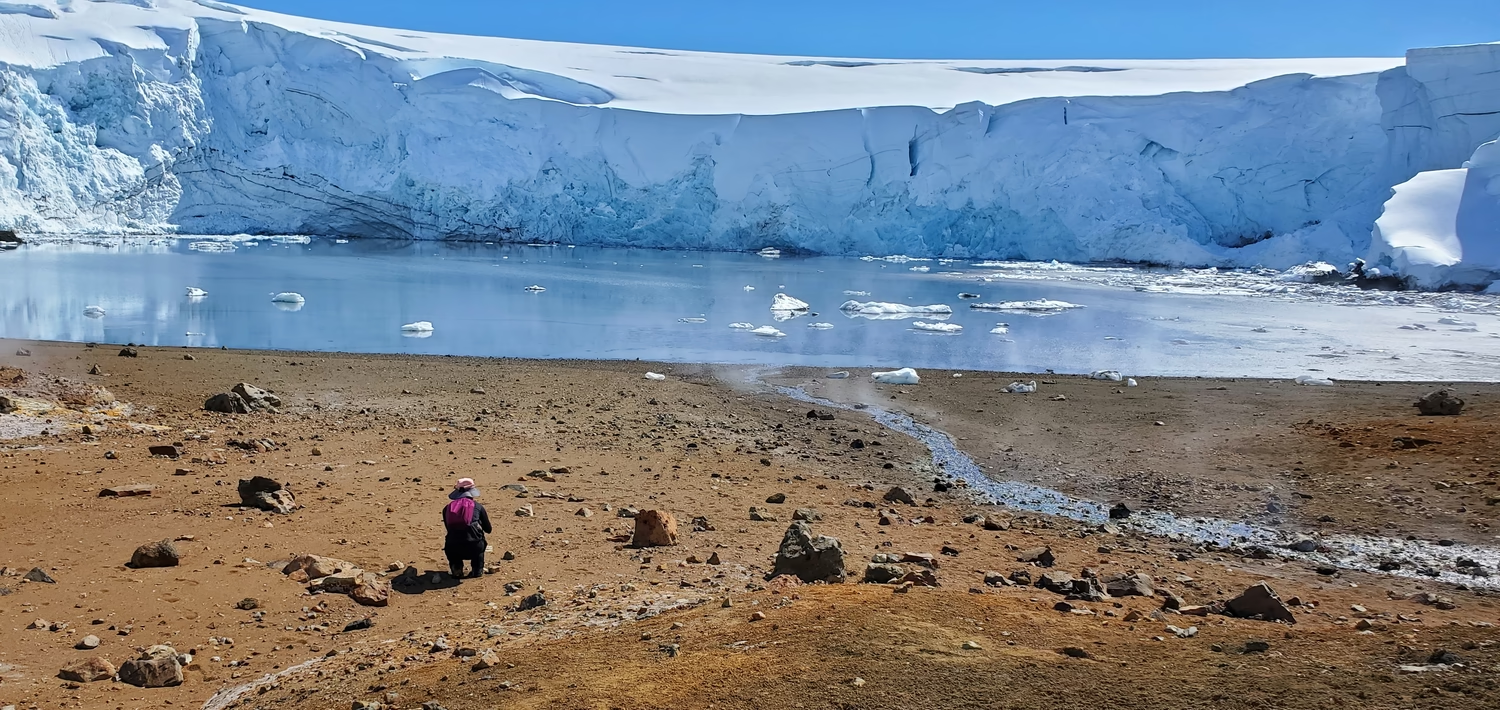
Sampling at a glaciovolcanic lake in Iceland during my PhD. One of the most remarkable field sites I've visited! A volcano beneath Europe's largest glacier melts the ice from below, forming a lake warm enough to swim in that's only exposed for a few months each year. These environments help us understand how life thrives at extremes and offer analogs for icy worlds beyond Earth.
What do you enjoy the most about your job?
Fieldwork, without question. When searching for biosignatures relevant to other planets, we focus on microorganisms: the most robust, resilient, and ancient forms of life our world has seen, and the most likely candidates we'd encounter elsewhere. To understand how these organisms survive and what chemical traces they leave behind, we often study environments where they dominate. In highly productive ecosystems, signatures from larger organisms like plants and animals overprint microbial traces, so we're drawn to extreme environments that stress life to its limits, places where only the most resilient creatures can survive.
This work has taken me to glaciovolcanic regions of Iceland where volcanoes are buried beneath glacier ice and form ephemeral oases, to the extreme aridity of the Mojave Desert, to the barren volcanic soils of Hawaii and Idaho. Exploring these places and witnessing, with my own eyes, how life persists despite overwhelming challenges gives me profound excitement about the possibility of life beyond our planet. There's something so hopeful about standing in these harsh landscapes and finding life in the most unlikely corners.
Fieldwork also keeps me personally connected to my research. I feel connected to the systems I study, and that connection fuels me through long lab days, though I genuinely love the lab work too! Beyond the science, working in the space sector has introduced me to the most enthusiastic, creative, bold, passionate people. I love being part of a community that thinks beyond the limits of our world. That collaborative spirit and boundless curiosity is so infectious!

Finding my first meteorite in Antarctica! A moment I'll never forget. Antarctica's ice sheets are one of the best places on Earth to find meteorites because the dark rocks stand out against the white ice, and the cold, dry conditions preserve them remarkably well. Each meteorite is a time capsule from the early solar system, offering clues about planetary formation and the building blocks that may have seeded life on Earth.
What does a typical day at work look like for you?
Once we've returned from the field with pristine samples, a huge priority is minimizing contamination in the lab itself. A lot of work goes into maintaining an exceptionally clean workspace. My supervisor has worked incredibly hard to eliminate sources of common laboratory contaminants, such as soft plastics, which can sequester and leach organic compounds. We use almost exclusively metal or glass tools because these can be thoroughly cleaned with solvents or baked at 500+ degrees C to combust any potential organic contaminants. So, my day often starts with preparing a clean workspace and meticulously cleaning the tools I'll need.
Once the workspace is ready, the focus shifts to extracting organics from my samples. We approach this in different ways depending on what we want to analyze and whether we are trying to replicate a spaceflight-like analysis. For soluble organics, I use solvent extractions, which involves soaking samples in specific organic solvents selected because they preferentially dissolve the target molecules we're interested in. After extraction, there are many steps involved in purifying the extracted molecules and concentrating them down to an extremely small volume, often just a few hundred microliters, before analyzing them on a gas chromatograph mass spectrometer (GCMS).
For organics that don't dissolve in solvents, particularly the refractory macromolecules I mentioned earlier, we use thermal techniques like evolved gas analysis, thermochemolysis, or pyrolysis. In all of these methods, the sample is placed in a furnace and heated either slowly or extremely rapidly, sometimes upwards of 1000°C. We capture the molecules released into the vapor phase due to thermal degradation and send them directly into the GCMS for analysis. This allows us to characterize compounds that would otherwise remain locked in complex organic matrices or hidden within mineral grains.
It's meticulous work, but there's something very satisfying about coaxing molecular fossils out of rocks and soil and seeing what story they have to tell.

Suiting up for science. When sampling for organics, contamination control is everything. Sterile gown, gloves, hair net, mask, and eye goggles (even eyebrow hairs could compromise our samples) are essential as they ensure that what we detect are environmental biosignatures, not traces of ourselves.
What science question intrigues you the most?
Whether there is life beyond Earth! I'm particularly excited by worlds that are theoretically habitable today, like the ocean worlds in our outer solar system, where liquid water still exists and the chemical conditions are suitable for life as we understand it. Did anything develop there? How would it relate to life on Earth? These questions could revolutionize our foundational understanding of biology.
On Earth, all life shares a common ancestor and operates on the same fundamental biochemistry. Finding life elsewhere, even within our own solar system, could tell us whether life is a cosmic inevitability or an extraordinary accident. If we discovered a second genesis of life, independent from our own, we could answer one of humanity's most profound questions: Are we alone? And perhaps more deeply, it would reveal whether the principles that govern life on Earth are universal laws like those of physics, or just one solution among many. That possibility drives me.
What is one thing you wish everyone knew about your particular field of science?
That you don't need to be a physicist or engineer to work in space exploration. Astrobiology is inherently interdisciplinary. It draws from biology, chemistry, geology, planetary science, and more. If you're curious about life and passionate about exploration, there's a place for you in this field, regardless of your background.
What keeps you inspired by your work?
The diversity of life on our planet. Between work and my hobbies, I spend a lot of time outside exploring and enjoying nature. Earth will forever be my favorite planet because the richness of biodiversity here is staggering. Every ecosystem, from the microscopic communities in desert soils to the complex web of life I get to explore in Shenandoah on the weekends, showcases life's incredible creativity and adaptability.
It makes me endlessly curious about what else is out there. What strange metabolisms, what unexpected chemistries, what novel survival strategies might exist on an icy moon or in the ancient lakes of Mars? The more I learn about life on Earth, the more I'm convinced we haven't even begun to scratch the surface of what life in the universe could look like. That sense of possibility, that there are discoveries waiting that could completely reshape our understanding of biology itself, keeps me inspired.
What do you like to do in your free time?
I love to hike and scuba dive! Any chance to be outside exploring, I’ll take it. I'm also an avid baker. Snickerdoodles and brownies are my go-to treats, and my coworkers have become (hopefully happy) taste-testers. Beyond that, I'm passionate about community service. I volunteer with science advocacy groups to make science more accessible, and I'm currently training to be an EMT in Maryland so I can give back to my community in a more direct, hands-on way outside of science.
Published Date: .
Hometown:
Peterborough, Ontario, Canada
Undergraduate Degree:
B.Sc. Earth and Environmental Science, McMaster University, Hamilton, Ontario, Canada
Post-graduate Degree:
PhD. Earth and Planetary Science, McGill University, Montreal, Quebec, Canada