Tuesday, April 30, 2024
03:45 PM - 05:00 PM
ASD Colloquium (Hybrid)
Exploiting the power of nearby laboratories to uncover the history of galaxies
Svea S Hernandez (STScI)
Metallicities of galaxies at all redshifts are critical for deciphering a plethora of physical and evolutionary processes taking place among and inside galaxies, including star formation, stellar feedback and interstellar/intergalactic chemical enrichment. Studies of local star-forming galaxies (SFGs) can be performed at exquisite signal-to-noise and spatial resolution, which are not achievable at higher redshift. Therefore, these studies establish a baseline in understanding how gas and stellar properties evolve through cosmic time. I take advantage of the unique FUV spectroscopic capabilities of the Hubble Space Telescope, along with the high sensitivity in the MIR of the James Webb Space Telescope (JWST), and complement our space observations with those from several ground-based telescopes to investigate a sample of local galaxies, which span a wide range in morphological types, metallicities and star formation rates. The results from my metallicity studies of nearby (<100 Mpc) galaxies will be discussed with a dedicated focus on their stellar, neutral-gas, and ionized-gas components. I will show how using spectroscopic observations of star clusters and their nearby gas allows us to observe the chemical evolution of galaxies through a much larger window in both space and time. Lastly, I will present some of the most recent results from our JWST program dedicated to dissect a key ingredient in the recipe for star formation: molecular gas. I will close with a brief discussion on the implications these data have in the understanding of the processes that drive the evolution of galaxies.
Read more about this event Svea S Hernandez (STScI)
Metallicities of galaxies at all redshifts are critical for deciphering a plethora of physical and evolutionary processes taking place among and inside galaxies, including star formation, stellar feedback and interstellar/intergalactic chemical enrichment. Studies of local star-forming galaxies (SFGs) can be performed at exquisite signal-to-noise and spatial resolution, which are not achievable at higher redshift. Therefore, these studies establish a baseline in understanding how gas and stellar properties evolve through cosmic time. I take advantage of the unique FUV spectroscopic capabilities of the Hubble Space Telescope, along with the high sensitivity in the MIR of the James Webb Space Telescope (JWST), and complement our space observations with those from several ground-based telescopes to investigate a sample of local galaxies, which span a wide range in morphological types, metallicities and star formation rates. The results from my metallicity studies of nearby (<100 Mpc) galaxies will be discussed with a dedicated focus on their stellar, neutral-gas, and ionized-gas components. I will show how using spectroscopic observations of star clusters and their nearby gas allows us to observe the chemical evolution of galaxies through a much larger window in both space and time. Lastly, I will present some of the most recent results from our JWST program dedicated to dissect a key ingredient in the recipe for star formation: molecular gas. I will close with a brief discussion on the implications these data have in the understanding of the processes that drive the evolution of galaxies.
Thursday, May 02, 2024
11:10 AM - 11:55 AM
Virtual Chat with the Code 600 Director
Everyone is Welcome!
ACTUAL TIME: 11:10 - 11:55
Read more about this event ACTUAL TIME: 11:10 - 11:55
Thursday, May 02, 2024
03:00 PM - 04:00 PM
AGN Seminar (Hybrid)
Integral Field Spectroscopy of low and high-redshift galaxies hosting supermassive black holes using ground-based and space telescopes
Darshan Kakkad
Over the past decade, spatially-resolved spectroscopy spanning optical, near & mid-infrared, and sub-mm wavelengths has played a pivotal role in providing insights into the influence of star formation and AGN feedback on the interstellar medium of host galaxies. Expanding our observational reach across a broader wavelength spectrum has granted us access to a diverse set of gas phases such as neutral, ionized, and molecular phases. Furthermore, advancements in spatial resolution have empowered us to zoom-in to the central regions of galaxies in finer detail, facilitating detailed studies of the torus structures and outflows originating from Active Galactic Nuclei on parsec scales. In this presentation, I will summarize findings from our recent observational campaigns focused on spatially-resolved spectroscopy, targeting both low and high redshift AGN host galaxies from BASS, SUPER, QFeedS and S7 surveys. These studies leverage state-of-the-art observatories such as the VLT, Keck, JWST, and ALMA. I will conclude by showcasing how the forthcoming Habitable Worlds Observatory will play a pivotal role in bridging crucial knowledge gaps, particularly through its capability to provide resolved UV spectroscopy in the future.
Read more about this event Darshan Kakkad
Over the past decade, spatially-resolved spectroscopy spanning optical, near & mid-infrared, and sub-mm wavelengths has played a pivotal role in providing insights into the influence of star formation and AGN feedback on the interstellar medium of host galaxies. Expanding our observational reach across a broader wavelength spectrum has granted us access to a diverse set of gas phases such as neutral, ionized, and molecular phases. Furthermore, advancements in spatial resolution have empowered us to zoom-in to the central regions of galaxies in finer detail, facilitating detailed studies of the torus structures and outflows originating from Active Galactic Nuclei on parsec scales. In this presentation, I will summarize findings from our recent observational campaigns focused on spatially-resolved spectroscopy, targeting both low and high redshift AGN host galaxies from BASS, SUPER, QFeedS and S7 surveys. These studies leverage state-of-the-art observatories such as the VLT, Keck, JWST, and ALMA. I will conclude by showcasing how the forthcoming Habitable Worlds Observatory will play a pivotal role in bridging crucial knowledge gaps, particularly through its capability to provide resolved UV spectroscopy in the future.
Tuesday, May 07, 2024
03:45 PM - 05:00 PM
ASD Colloquium (Hybrid)
Tarraneh Eftekhari (Northwestern)
Read more about this event Wednesday, May 08, 2024
11:00 AM - 12:00 PM
GSFC AI Center of Excellence Seminar
Wednesday, May 08, 2024
01:00 PM - 04:30 PM
Workshop for ROSES Proposal Writers
SPSO will offer a Workshop for ROSES Proposal Writers. We do this at least annually and each time address new features of the Research Opportunities in Space and Earth Science (ROSES) solicitation. We encourage in-person attendance.
12:45 – 1:00 pm: Sign into virtual meeting, work out kinks, share stories
1:00 – 1:15 pm: What are Research and Analysis (R&A) proposals?
1:15 – 1:45 pm: How are R&A proposals evaluated?
1:45 – 2:00 pm: How do I find R&A opportunities?
2:00 – 2:15 pm: 15-minute break
2:15 – 3:00 pm: What are Goddard’s policies and Best Practices for proposal writers?
3:00 – 3:20 pm: How do I create a budget?
3:20 – 4:35 pm: How do I create a persuasive proposal?
Read more about this event 12:45 – 1:00 pm: Sign into virtual meeting, work out kinks, share stories
1:00 – 1:15 pm: What are Research and Analysis (R&A) proposals?
1:15 – 1:45 pm: How are R&A proposals evaluated?
1:45 – 2:00 pm: How do I find R&A opportunities?
2:00 – 2:15 pm: 15-minute break
2:15 – 3:00 pm: What are Goddard’s policies and Best Practices for proposal writers?
3:00 – 3:20 pm: How do I create a budget?
3:20 – 4:35 pm: How do I create a persuasive proposal?
FEATURED STORY
Mission Posters
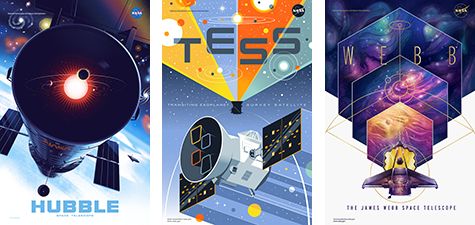
Please check out these awesome mission posters for the Hubble Space Telescope, the Transiting Exoplanet Survey Satellite (TESS) and the James Webb Space Telescope missions.Featured Video
Celebrating 30 years in orbit, the Hubble Space Telescope has revealed astonishing secrets about our universe. Yet, while its most famous pictures may reveal galaxies and nebulas across the cosmos, it’s also unlocked secrets here in our own solar system.
Congratulations to the following 660 members for receiving Agency Honor Awards! Scott Barthelmy: Exceptional Public Service Medal Koji Mukai: Exce...
Monday, April 01, 2024Ken Carpenter (667) and his team have been awarded a prestigious and highly competitive NIAC grant to perform a study for an optical-UV interferometry...
Thursday, January 04, 2024