Local News
Showing 1 to 24 of 140.
BurstCube Deployed
2024.04.18
At 7:26 this morning, BurstCube was successfully deployed from the ISS. The team now awaits the opportunity to communicate with the satellite, some time over the next few days. Congratulations to Jeremy Perkins, Judy Racusin, and the entire BurstCube team for reaching this milestone. This is a landmark event for 660, as it is our first CubeSat.
Congratulations OSIRIS-REx Team!
2024.04.03
The OSIRIS-Rex Team has been awarded the prestigious award for innovation in aviation, The Collier Trophy. Additionally, they also took home the Robert H. Goddard Memorial Trophy AND the American Astronautical Society's Neil Armstrong Space Flight Achievement Award.
PACE Mission Blog: Liftoff! NASA’s Earth Science Mission Launches Into Space Coast Sky
2024.02.08
3, 2, 1 … LIFTOFF! A SpaceX Falcon 9 rocket carrying NASA’s PACE (Plankton, Aerosol, Cloud, ocean Ecosystem) spacecraft launched on a SpaceX Falcon 9 rocket from Cape Canaveral Space Force Station’s Space Launch Complex 40 at 1:33 a.m. EST Thursday, Feb. 8.
Shawn Domagal-Goldman new Deputy Director for SED
2023.10.22
Dr. Shawn Domagal-Goldman joined us on October 22 in the Front Office as Deputy Director of the Sciences and Exploration Directorate! Shawn joins the SED management team from his role as the Program Scientist for the Great Observatories Maturation Program (GOMAP), which is currently focused on the Habitable Worlds Observatory. Shawn will prove an invaluable member of the Sciences and Exploration Directorate management team as we conduct NASA’s scientific mission. His unique expertise in Astrobiology, with interdisciplinary scientific and programmatic connections across Planetary Science and Astrophysics, will be a valuable addition to the Sciences and Exploration Directorate management team.
Dr. Jane Rigby Named New Webb Telescope Senior Project Scientist
2023.06.28
NASA has chosen Dr. Jane Rigby as the new senior project scientist for the James Webb Space Telescope mission. Rigby is an astrophysicist at NASA’s Goddard Space Flight Center, in Greenbelt, Maryland, and has worked on the mission for many years. Rigby was one of the three commissioning scientists for Webb. She also led the characterization of Webb’s science performance. She is an active researcher studying how galaxies form stars, and leads one of Webb's Early Release Science programs. She steps in after John Mather, who held the position for almost 28 years since 1995. Mather is moving on to senior project scientist emeritus for Webb at NASA.
2023 Poster Party Blowout winners announced
2023.02.16
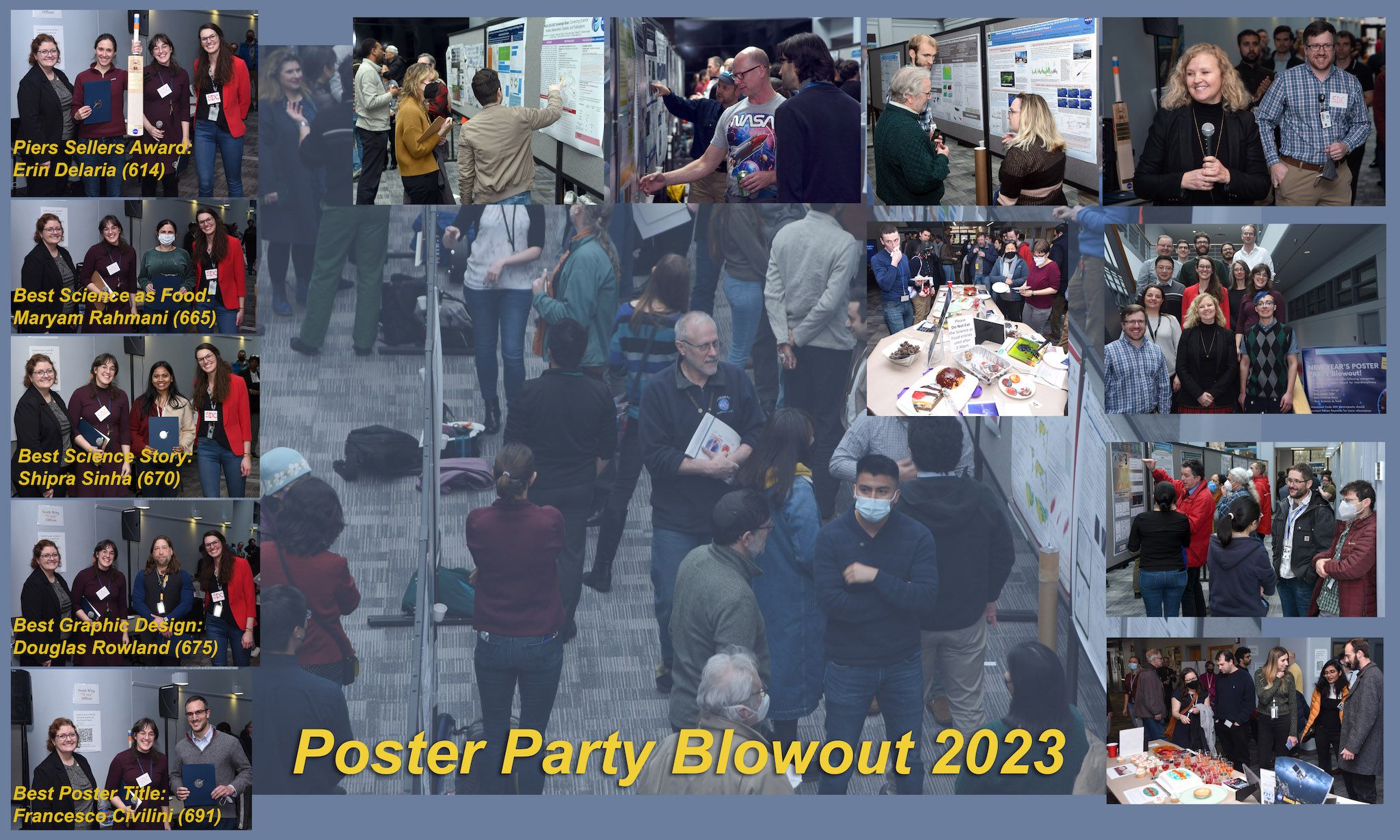
We had over 175 posters from all four science divisions, as well as a few select entries from the Engineering and Technology Directorate. As one of the few yearly events that brings together the whole Sciences and Exploration Directorate, the large turnout (including GSFC and HQ VIPs) and collaborative communication made the event a great success! While there were so many fantastic contributions, awards were given for outstanding posters in 5 categories:
- Best Poster Title:
Francesco Civilini (690.1) - How to Train your Lander: Automatic moonquake detection using machine learning - Best Graphic Design:
Douglas Rowland (675) - The Geospace Dynamics Constellation mission: NASA's next Living With a Star mission to explore the upper atmosphere - Best Science as Food:
Maryam Rahmani (665) - Cosmic Microwave Background/Line Intensity Mapping cake and jell-o - Best Science Story:
Shipra Sinha (670) - The Mystery of Magnetospheric Substorms - Piers Sellers Interdisciplinary Award:
Erin Delaria (614) - The NASA Carbon Airborne Flux Experiment (CARAFE): Observations of Greenhouse Gas Exchange in the Florida Everglades
Peters-Lidard Elected Member of National Academy of Engineering
2023.02.07
Congratulations to Dr. Christa Peters-Lidard, Director of the Sciences and Exploration Directorate, for being named one of three NASA-affiliated newly-elected members of the National Academy of Engineering (NAE). Election to the NAE is among the highest professional distinctions accorded to an engineer. Dr. Peters-Lidard was honored for contributions to understanding land-atmosphere interactions, soil moisture monitoring and modeling, and leadership in Earth system modeling.
Three SED Scientists named 2022 AAAS Fellows
2023.01.31
Three Sciences and Exploration Directorate scientists have been named 2022 fellows by the American Association for the Advancement of Science (AAAS) in recognition of their scientifically and socially distinguished achievements in the scientific enterprise. Rita Sambruna (600) was recognized in Astronomy, Jennifer Wiseman (660) was recognized in Physics, and Dorothy Peteet (611) was recognized in Earth Science. Congratulations to all!
Dr. Jonathan Gardner Selected as the Winner of the 2022 John C. Lindsay Memorial Award for Space Science.
2022.11.18
Dr. Gardner is being recognized for his exceptional scientific leadership of the James Webb Space Telescope (JWST) Science Teams. He is the Deputy Senior Project Scientist for the James Webb Space Telescope, a position he has held since 2002 at NASA's Goddard Space Flight Center.
Dr. Jane Rigby to receive AAS Kavli Plenary Lectureship award
2022.10.06
Dr. Jane Rigby from the Astrophysics Science Division and Project Scientist for Operations for the James Webb Space Telescope, will receive the American Astronomical Society’s (AAS) Fred Kavli Plenary Lectureship award at the 241st AAS meeting in Seattle, Washington, on Jan. 9, 2023.
With support from the Kavli Foundation, the vice presidents of the AAS name a special invited lecturer to kick off each semiannual AAS meeting with a presentation on recent research of great importance.
Dr. George Huffman Named Recipient of 2022 William Nordberg Memorial Award for Earth Science
2022.08.11
We are thrilled to announce the selection of Dr. George Huffman as the 2022 William Nordberg Memorial Award for Earth Science recipient.
Dr. Huffman is being recognized for outstanding contributions to, and leadership of, algorithm development, science, and applications of the TRMM and GPM multi-satellite precipitation analyses.
Dr. Huffman received his B.S. in Physics at The Ohio State University (1976) and a Ph.D. in Meteorology at Massachusetts Institute of Technology (1982). He then was an Assistant Professor at University of Maryland, College Park, then moved to GSFC in 1988, where he consulted until entering government service in 2012. Dr. Huffman’s primary focus has been the design, implementation, and extension of combined (satellite-gauge) estimates of global precipitation. The resulting data sets include the Global Precipitation Climatology Project (GPCP) monthly and daily products (carried out as a contribution to the World Climate Research Program, WCRP); the NASA Tropical Rainfall Measuring Mission (TRMM) Multi-satellite Precipitation Analysis; and the successor NASA Global Precipitation Measurements (GPM) mission’s Integrated Multi-satellitE Retrievals for GPM (IMERG). Allied work includes estimating errors and extreme precipitation event statistics. Dr. Huffman is the Project Scientist for GPM, as well as the lead for the GPM Multi-satellite Algorithm Team. His research has resulted in 145 publications, 15 as first author, and numerous presentations. As well, he is the Chief for the Mesoscale Atmospheric Processes Lab, Code 612, at GSFC. Recent awards include NASA/GSFC Special Act Team Award, Earth Sciences Division Lab Management, 2021; NASA/GSFC Robert H. Goddard Group Award for Science, IMERG Development Team, 2019; Fellow of the American Meteorological Society, 2019; and NASA Exceptional Service Medal, 2018.
George will be presented with the William Nordberg Memorial Award during a future Scientific Colloquium.
Rosenzweig Receives 2022 World Food Prize
2022.05.05
Cynthia Rosenzweig, a senior research scientist and head of the Climate Impacts Group at NASA’s Goddard Institute for Space Studies (GISS) in New York City, received the 2022 World Food Prize from the World Food Prize Foundation. According to the World Food Prize Foundation, the World Food Prize is a prestigious international award conceived as the "Nobel Prize for Food and Agriculture" with a mission to elevate innovations and inspire action to sustainably increase the quality, quantity and availability of food for all.
Rosenzweig was selected for the award for her research to understand the relationship between climate and food systems and forecast how both will change in the future. Her modeling work has provided a foundation for decision-makers around the world to create strategies to mitigate climate change and adapt our food systems to a changing planet, which has helped communities worldwide address the consequences of Earth’s changing climate.
Jane Rigby Named 2022 LGBTQ+ Scientist of the Year
2022.05.02
Out to Innovate's LGBTQ+ Scientist of the Year Award recognizes an individual who has made outstanding contributions to their field through design, research, or management. This year’s award winner is Dr. Jane Rigby, an astrophysicist at the NASA Goddard Space Flight Center and the Operations Project Scientist for NASA’s JWST. In addition to her work with JWST, Rigby and her team at NASA, with international collaborators, have led many successful research campaigns, collecting data from the Keck and Magellan Observatories and the Hubble Space Telescope. She has published over 100 peer-reviewed publications. She also has given countless professional and public presentations on her research and on JWST and served on the 2020 Decadal Survey of Astronomy and Astrophysics for the National Academies. Rigby has been recognized for her research, mentorship, and diversity-related work with awards such as the John C. Lindsay Memorial Award for Space Science.
The Rossi Prize, Top High-Energy Award, Given to NICER Mission
2022.03.22
The top prize in high-energy astrophysics has been awarded to the Neutron Star Interior Composition Explorer (NICER) team for the instrument and the revelations it is producing about the physics of neutron stars and their environments. The High Energy Astrophysics Division (HEAD) of the American Astronomical Society (AAS) awards the Rossi Prize in recognition of significant contributions as well as recent and original work in high-energy astrophysics.
Kirschbaum Receives 2022 NOAA-David Johnson Award
2022.02.28
Dr. Dalia Kirschbaum has been named as the National Space Club and Foundation's 2022 NOAA-David Johnson Award recipient. The award will be presented at the 65th Annual Dr. Robert H. Goddard Memorial Dinner on March 18, 2022. Congratulations, Dalia!
Mark Clampin named recipient of the Presidential Rank Award of Meritorious Executive
2022.01.27
Congratulations to our very own Mark Clampin – Director of Sciences and Exploration – who has been named a recipient of the Presidential Rank Award of Meritorious Executive! This is a highly prestigious honor given by the administration to recognize members of the Senior Executive Service for their exceptional performance over time. Among countless accomplishments in several leadership positions, Mark has continued our legacy as one of the best scientific organizations in the world. This latest honor underscores the years of contributions he has made to NASA, Goddard and our nation. Read the press release
Lynnae Quick - 2021 Harold C. Urey Prize
2021.08.12
The 2021 Harold C. Urey Prize for outstanding achievement in planetary research by an early career scientist is awarded to Dr. Lynnae C. Quick. Dr. Quick’s innovative scientific work focuses on geophysical processes writ large, reaching from the inner solar system, through the asteroid belt, to ocean worlds, and into the exoplanetary realm. She has revisited modeling of (cryo)lava domes on Venus and Europa, was the first to model the formation of Ceres’ “bright spots” via the transport of material from a deep brine reservoir to the surface, has repeatedly provided new insights into plumes on Jupiter’s moon Europa, and shed light on the abundance of extrasolar ocean worlds. In addition to her scientific pursuits, Dr. Quick is exceptionally engaged in the broader research community through her proactive leadership as a co-investigator on several space missions, as a member of the Outer Planets Assessment Group steering committee, the Planetary Science Decadal Survey 2023-2032 panel on ocean worlds and dwarf planets, and the National Society of Black Physicists. Dr. Quick’s advocacy work to diversify the field is particularly notable. She has mentored many early career planetary scientists and is leading the Dragonfly Student and Early Career Investigator Program. Every aspect of Dr. Quick’s career represents a positive outlook for the future of our community.
Dr. Randal Koster Named Recipient of 2021 William Nordberg Memorial Award for Earth Science
2021.08.02
We are thrilled to announce the selection of Dr. Randy Koster as the 2021 William Nordberg Memorial Award for Earth Science recipient.
Dr. Koster is being recognized for research that has provided unique insights in the field of hydrology, combining modeling efforts with space-based observations, putting GSFC at the forefront of Earth science.
Dr. Koster has worked at NASA GSFC since September of 1987, first as a member of the Hydrological Sciences Branch, and currently as a member of the Global Modeling and Assimilation Office (GMAO). His early work focused on the analysis of global water isotope geochemistry. Most of his tenure at GSFC, though, has been dedicated to two research thrusts: (i) the development of improved treatments of land surface physics for Earth system models, and (ii) the analysis of interactions between the land and atmosphere, using these models. He has examined many questions regarding land-atmosphere feedback, including: Can knowledge of soil moisture conditions at the beginning of a seasonal weather forecast improve the forecast? Can we find evidence in the observational record that variability in land surface states has an effect on rainfall, air temperature, and other atmospheric variables? He has coordinated multi-institutional analyses of land-atmosphere feedback for two components of the World Climate Research Programme. He serves on the Soil Moisture Active Passive (SMAP) Science Team, focusing on making sure that SMAP satellite-based soil moisture data is useful for climate studies and other applications.
With the advent of the GMAO in 2003, Dr. Koster was given the responsibility of coordinating the land surface modeling activities at GSFC into a single land surface modeling system. This ever-evolving system is used extensively by the GMAO and is available for use by the NASA community.
Randy will be presented with the William Nordberg Memorial Award during a future Scientific Colloquium that will be scheduled once we are all back on Center.
Earth Month at Goddard Begins April 1
2021.03.26
Beginning April 1, the Goddard Earth Sciences Division will host Earth Month at Goddard – a series of events throughout April featuring some of the center’s world-renowned experts in Earth science.
The first event will feature Earth Sciences Director Dr. James R. Irons and Goddard Institute for Space Studies Chief Dr. Gavin A. Schmidt on Thursday, April 1, from 11:30 a.m. to 12:30 p.m. ET as they present “Don’t forget the science! NASA’s contributions to climate policy.”
Schmidt Heard on Science Friday
2021.02.26
Gavin Schmidt (611) was recently featured in Science Friday’s “Keeping and Eye on the Climate, From Space” segment where he discussed the upcoming NASA climate-focused programs, the past week’s weather in Texas, and provided insight on making decisions regarding the uncertainties about the future of climate.
Rita Sambruna and Richard Mushotzky Selected as AAS Fellows
2021.02.02
Rita Sambruna is cited “For exceptional contributions to the fundamental understanding of relativistic jets from supermassive black holes, for being an ally to, and role model for, underrepresented groups in the field; and for leadership and service.” Richard Mushotzky, who retired from GSFC and is now a professor at the University of Maryland, is cited “For his leadership in X-ray and multiwavelength imaging, timing, and spectroscopy focusing on the physics of black hole accretion, evolution of the elements, and cosmology.”
AGU Honor Awards
2020.11.12
Congratulations to two of SED's scientists, who were awarded AGU Honor Awards. The AGU states, “These individuals embody our shared vision of a thriving, sustainable, and equitable future for all powered by discovery, innovation, and action.”
Dr. Claire L. Parkinson (Code 610) is awarded the Roger Revelle medal. The Roger Revelle Medal is given annually to one AGU honoree in recognition of outstanding contributions in atmospheric sciences, atmosphere-ocean coupling, atmosphere-land coupling, biogeochemical cycles, climate or related aspects of the Earth system.
Dr. Barbara L. Giles (Code 670) is awarded the Edward A. Flinn III Award. The Edward A. Flinn III Award is given annually to mid-career or senior scientists, either individually or in a small group, who personifies AGU’s motto ‘unselfish cooperation in research’ through their facilitating, coordinating, and implementing activities. This award is for the unsung heroes who provide the ideas, motivation, and labors of love that build and maintain the infrastructure without which our science could not flourish.
Two SED Scientists Honored as APS Fellows
2020.10.13
Li-Jen Chen was nominated by the APS Division of Plasma Physics for pioneering observational and theoretical contributions to the understanding of collisionless plasma dynamics; especially collisionless magnetic reconnection.
Rita M. Sambruna was selected by the APS Division of Astrophysics for exceptional contributions to the fundamental understanding of relativistic jets from supermassive black holes, and for leadership in, and service to, the field of astrophysics.
Virtual Visitor Center Sunday Experiment - OSIRIS-REx
2020.10.08
On Oct. 20, in NASA’s first-ever asteroid sample collection attempt, the Origins, Spectral Interpretation, Resource Identification, Security-Regolith Explorer (OSIRIS-REx) spacecraft will attempt to collect a sample from near-Earth asteroid Bennu. Celebrate with us on social media with #ToBennuAndBack!
Visit the Sunday Experiment page on the GSFC Visitor Center site to find activities you can do at home, videos, stories, and how to promote the Touch-and-go event via social media. And check out the OSIRIS-REx resource package for more!
Showing 1 to 24 of 140.